
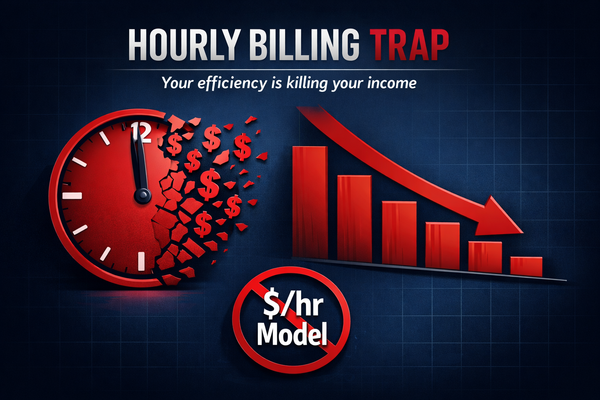
Consultants rushing into AI services with hourly billing are pricing themselves into a corner they can't escape. Here's what the data shows about why your current consulting rate structure won't survive first contact with AI clients.
Research from Consulting Success shows that 25% of consultants still lower their fees to win clients, undermining how they're perceived and creating unsustainable business models. When you add AI services to this existing pricing problem, you create a situation that gets worse fast. The efficiency gains that make AI consulting effective are the same factors that make billing by the hour unsustainable.
The consulting industry has shifted dramatically since 2020. Remote work normalization, AI integration, and economic uncertainty have created both opportunities and pricing pressures that didn't exist just a few years ago. According to recent market analysis, consultants who proactively address these changes in their pricing models maintain profitability while demonstrating professional business practices. Those who don't find themselves trapped in an exhausting cycle of working more hours to earn the same money.
When you bill by the hour for AI implementation, you're signaling to clients that what you're offering is time, not outcomes. That puts you at a strategic disadvantage from the beginning.
The data is clear. Value-based pricing models are becoming increasingly common in consulting, with firms tying their compensation to measurable business outcomes rather than time and materials. This approach aligns consultant incentives with client success, but it requires a complete rethinking of how you structure and present your services.
You can't just add AI consulting to your existing hourly rate sheet and expect it to work. The nature of AI implementation, the expectations of AI clients, and the economics of this change all point to one conclusion: your current pricing structure will limit your income, frustrate your clients, and prevent you from scaling the practice you're trying to build.
The Problem With Hourly Billing
When you master AI tools and frameworks, you get faster at solving problems. You develop systems that work and build repeatable processes that deliver consistent results. This expertise should make you more valuable, but billing by the hour punishes you for every efficiency gain you achieve.
According to Consulting Success research on value-based pricing, when you use AI to research, analyze data, and prepare recommendations in a fraction of the time, your compensation decreases under time-based models. The business impact for your client remains the same or increases, but you earn less because you finished faster. Your efficiency becomes your enemy.
Think about what happens when you implement AI for a client. You spend weeks learning their business, understanding their processes, and identifying where AI can create the most impact. You develop custom prompts, build frameworks, and create systems that transform how they work. After the first implementation, you know exactly how to replicate this success for similar clients.
With time-based billing, your second client pays less than your first because you're faster. Your tenth client pays even less. You've become an expert, but your income decreases with every successful project. The better you get at AI implementation, the less money you make per engagement.
SystemX analysis of consultant pricing trends highlights this problem clearly. A consultant who solves a complex AI implementation problem in three hours earns a fraction of what they would make stretching the work across a week. Clients feel frustrated paying premium by-the-hour rates for quick solutions, wondering why expertise comes with such steep time-based costs.
This creates a conflict that damages your client relationships from the start. Your interests become misaligned with your clients' interests. They want solutions delivered fast and efficiently. You need billable hours to make money. This tension exists in every conversation, every project update, and every invoice you send.
The AI tools you use to help clients make this worse. When you use ChatGPT, Claude, or Perplexity to accelerate research, analysis, or content creation, you're reducing your billable time. The technology that makes you more valuable to clients simultaneously reduces what you can charge them under hourly models.
You hit an income ceiling quickly. There are only so many hours in a week, and you can only raise your hourly rate so much before clients push back. According to data from Consulting Success, even specialist consultants charging $250 or more per hour face natural limits. Time remains your constraint, and no amount of expertise changes that fundamental limitation.
Clients start micromanaging your time instead of focusing on results. They question every phone call, every email, and every moment of strategic thinking time because in their mind, thinking equals billing. This scrutiny creates an environment where you're constantly justifying your hours rather than demonstrating your value.
That causes consultants to either burn out working excessive hours to maintain income, or start padding hours to compensate for their increased efficiency. Neither option builds a sustainable AI consulting practice. Both approaches erode trust and limit your ability to scale.
Your AI expertise compounds this problem in ways traditional consulting never did. When you become skilled at Scalable Prompt Engineering™ or master the AI Strategy Canvas® framework, you can deliver transformational results faster than ever before. But faster delivery under hourly billing means smaller paychecks, creating a system where your growing expertise actually hurts your income.
This is why the consulting industry is abandoning hourly pricing for AI work. The model doesn't align with how results are delivered in AI projects. Your clients care about the revenue increases, cost reductions, and competitive advantages you help them achieve. They don't care whether those outcomes took you 10 hours or 100 hours to deliver.
The uncomfortable truth is that hourly billing for AI consulting creates a business model that penalizes excellence and rewards inefficiency. Every time you improve your processes, refine your frameworks, or develop better systems, you reduce your income under this pricing structure. That's not a sustainable way to build the AI practice you're planning.
AI Clients Want Outcomes Not Hours
The businesses investing in AI implementation don't care about your time sheets. They care about whether their sales team can close deals faster, whether their customer service handles twice the volume, or whether their operations cut costs by 30%. When you walk into an AI consulting conversation focused on hours, you've already lost the positioning battle.
Recent analysis from SystemX shows that today's clients are data-savvy, outcome-obsessed, and skeptical of anything that feels like process over results. They don't want to hear about your billable hours. They want to know how you'll solve their problems and what it means for their bottom line.
This shift accelerates dramatically with AI projects. When a company decides to implement AI across their organization, they're making a strategic bet on change. They're not buying consulting hours, but rather, the capability to compete in a market where AI adoption determines winners and losers.
Think about what happens in a typical AI consulting sales conversation. The prospect asks what you charge, and you respond with your hourly rate. Maybe it's $200 an hour, $350, or even $500. That number sits there between you and the client, creating immediate questions rather than confidence.
According to research on consultant pricing from Consulting Success, stating an hourly rate doesn't convey value. A $450 per hour price tag alone isn't a compelling reason to buy. In fact, by itself, it often scares potential clients away because they're calculating hours in their head, trying to estimate total costs without understanding what they're actually getting.
Companies implementing AI need strategic partners who understand both technology and business outcomes. They need consultants who can articulate specific, measurable goals like increasing sales by 15%, reducing customer churn by half, or cutting operational costs by 25%. When you respond to these needs with time-based pricing, you're answering a different question than the one they're actually asking.
The market data supports this completely. The AI consulting market is projected to grow from $8.75 billion in 2024 to $58.19 billion by 2034, driven by increasing enterprise AI adoption and the need for specialized implementation expertise. This growth comes from businesses investing in outcomes, not from companies buying consultant hours in bulk.
Your AI clients face real pressure. Their competitors are implementing AI, employees need training, and processes need optimization. They're looking for consultants who can deliver measurable results, not timekeepers who can log hours efficiently. When you price by the hour, you're positioning yourself as the latter.
Consider what an AI implementation involves. You're helping businesses rethink their workflows, train their teams, implement new technologies, establish governance frameworks, and measure results. Each of these components drives measurable business outcomes, revenue increases, cost reductions, productivity improvements, risk mitigation, and competitive advantages.
None of these outcomes have a direct relationship to the hours you spend creating them. A brilliant insight that saves a company $500,000 annually has the same value whether it took you three hours or three weeks to develop. But under hourly billing, the 3-hour insight generates a tiny fraction of the revenue compared to the 3-week project.
This creates conversations that feel wrong from the beginning. Instead of discussing the changes your client needs and what achieving them would mean for their business, you're negotiating hourly rates and trying to estimate how many hours the project might require. You're focused on inputs rather than outputs, process rather than results.
The consulting industry recognizes this problem. According to research, value-based pricing models are becoming increasingly common, with consulting firms tying their compensation to measurable business outcomes rather than time and materials. This approach aligns consultant incentives with client success and creates relationships built on shared goals rather than time tracking.
AI implementation projects magnify this misalignment. When you help a client implement the INGRAIN AI Roadmap, you're delivering strategic frameworks, organizational change management, training programs, and ongoing optimization. The value comes from the systematic approach and the business results it generates, not from counting the hours spent in meetings or building training materials.
Companies investing in AI want consultants who think like business partners. They want expertise focused on their success. They want clear outcomes tied to measurable business results. When you show up with by-the-hour pricing and time estimates, you're signaling that you're a service provider rather than a strategic advisor. That positioning limits both your fees and your impact.
The shift toward outcome-based relationships reflects what clients need. With AI tools handling more routine work, the value consultants provide is becoming more strategic and less time-dependent. Your worth isn't in the hours you log; it's in the changes you enable and the results you help achieve.
Your Income Ceiling Appears Faster Than You Think
The math of hourly consulting is brutal, and most consultants don't realize how quickly they hit their limit until they're already stuck. You can only work so many hours, charge so much per hour, and bill so many weeks per year before the numbers simply stop working in your favor.
Most consultants only bill 50 to 60% of their working hours. If you work 2,000 hours annually, expect only 1,000 to 1,200 to be billable. The rest goes to business development, administration, learning, and all the other activities required to keep your practice running.
Let's look at real numbers. If you charge $250 per hour and bill 1,000 hours per year, you gross $250,000. That sounds reasonable until you account for taxes, health insurance, retirement savings, business expenses, and the reality that you're working far more than 1,000 hours to generate that income. Your actual take-home is significantly less.
Now consider what happens when you try to scale. You can raise your rate to $300, $350, or even $400 per hour. According to the data, 28% of specialist consultants charge $250 or more per hour, but only a small fraction can command rates significantly higher than that. There's a natural ceiling where clients push back regardless of your expertise.
You can try working more hours, but you quickly hit physical and mental limits. Billing 1,200 hours while maintaining quality is challenging. Billing 1,500 hours while handling business development, client management, and continuous learning becomes nearly impossible. Your capacity maxes out, and with it, your income potential.
Consulting expert Melisa Liberman emphasizes how this ceiling appears quickly. The potential downside of project-based consulting fees is that, if not done well, you can set yourself up for a low profit, no profit, or even loss situation. This happens when you underestimate the time required, the materials needed, or if you don't establish clear scope boundaries.
For AI consulting, this problem intensifies. You're competing in a market where businesses need comprehensive solutions, not piecemeal hourly work. They need strategic planning, team training, governance frameworks, ongoing support, and measurable results. Delivering all of this while billing by the hour means either underpricing the full scope or presenting estimates that scare prospects away.
Consider what a typical AI implementation requires:
Executive alignment sessions
AI literacy training for leadership teams
Department-specific skill development
Custom GPT creation
Policy and governance setup
Enterprise-wide rollout
Performance measurement
Each component takes time, but the real value comes from how they work together to create lasting organizational change.
When you price this work hourly, you face an impossible choice. Either you provide a detailed hour estimate that totals to a number that feels enormous to the client, or you underestimate to win the deal and then struggle to deliver profitably. Neither option positions you for success.
The data shows what happens to consultants stuck in this model. Of consultants making $2,000 to $5,000 per month, 64% of them are charging less than $250 per hour. For consultants making $10,000 to $45,000 per month, 37% are still charging less than $250 per hour. The correlation is clear. Hourly billing keeps most consultants at lower income levels regardless of their expertise.
Square's analysis of consulting fees points out another limitation. Your general location plays a part in your pricing. Consultants in coastal or urban cities can often charge higher rates, but that also means higher overhead. Those in smaller markets face even tighter ceiling constraints based on local expectations and competition.
AI consulting demands a different approach because the work itself doesn't scale under hourly models. When you develop a custom GPT for one client's sales team, that expertise transfers to your next client. When you implement the AI Strategy Canvas with one organization, you can replicate that process faster and better with subsequent clients. Your value increases while your time investment decreases.
Under time-based billing, this improved efficiency works against you. Your income per project drops as you get better at delivery. You're penalized for the expertise and systems you've developed. The only way to maintain income is to continuously find new clients and start from scratch with each one, never benefiting from the knowledge and frameworks you've built.
The ceiling appears in another way too. Clients start viewing you as a cost center rather than an investment. They compare your rate by the hour to their employees' salaries. They question why they should pay you $300 per hour when they could hire someone full-time for less. This comparison ignores your specialized expertise, but it happens constantly when you price by the hour.
You also can't effectively delegate or build a team under hourly models without significantly complicating your pricing. If you bring in junior consultants or specialists at lower rates, clients wonder why they should pay your full rate for coordination. If you charge everyone at the same rate, your margins disappear. The model simply doesn't support growth beyond you as a solo practitioner.
The consulting market has recognized these limitations. Top-tier firms like McKinsey, BCG, and Bain lean heavily toward fixed fee pricing models, especially for large, high-stakes engagements. They use fixed fees to provide clients with clear cost expectations, ensure alignment of project goals, and focus on outcomes rather than timekeeping.
Your AI consulting practice deserves the same structural foundation that allows for real growth. When your income is directly tied to hours worked, you're building a job, not a business. You're trading time for money with a hard ceiling that appears faster than you expect and limits both your earning potential and your ability to scale.
What Premium AI Consultants Price Instead
The consultants building sustainable AI practices are selling outcomes, frameworks, and systematic approaches that create measurable business value. This shift in pricing structure changes everything about how they position their services and what they can charge.
Premium AI consultants structure their services around specific deliverables and results. They create packages that solve complete problems rather than billing for fragmented hours. An AI implementation program might include executive alignment, governance framework setup, leadership training, department-specific skill development, and ongoing optimization support, all priced as a comprehensive solution.
This approach requires a different conversation model. You need to become excellent at the "value conversation." This means asking questions that help your client articulate not just what they want, but what achieving it is worth to them. You're uncovering both tangible outcomes such as increased revenue, reduced costs, and improved efficiency, as well as intangible benefits like risk mitigation and competitive advantage.
One of the most powerful questions comes from strategic coach Dan Sullivan, "If we were having this discussion three years from today, and you were to look back over those three years, what would have to happen, both personally and professionally, for you to feel happy about your progress?" This question forces clients to think beyond the immediate problem to the bigger changes they're seeking.
The INGRAIN AI™ Certified Implementer program demonstrates this pricing approach in action. Certified implementers keep 100% of revenue when directly training corporations using proven frameworks. Daily consulting rates range from $5,000 to $25,000 or more depending on engagement complexity. These are fixed fees tied to specific outcomes and deliverables.
Consider how this changes the client conversation. Instead of saying, "I charge $350 per hour for AI consulting," you present a structured offer. "I have a specific program where I'll take you through executive alignment, governance setup, and leadership skill development. We'll implement the AI Strategy Canvas across your organization, train your department leaders in Scalable Prompt Engineering, and establish your internal AI champion network. The investment is $55,000, and based on similar clients, you should see measurable productivity improvements within 60 days."
This pricing model scales with your expertise rather than your time. When you master the INGRAIN AI Roadmap process, you can deliver it more efficiently to each subsequent client. Your fee remains tied to the value created, not the hours invested. The better you get, the more profitable each engagement becomes.
Premium consultants also structure ongoing relationships differently. Rather than open-ended hourly retainers, they create outcome-focused support packages. Monthly AI optimization consulting might include strategic guidance, performance reviews, and framework refinements for a fixed monthly fee that reflects the ongoing value rather than estimated hours.
The key is structuring your AI consulting practice from the beginning around the pricing model that supports growth. When you launch AI services with hourly billing, you're building limitations into your foundation. When you start with outcome-based pricing, productized packages, and wholesale training options, you're creating a business that scales with your expertise rather than your available hours.
Premium AI consultants also use their certification and proven frameworks as pricing justification. Being an INGRAIN AI Certified Implementer signals mastery of systematic approaches that deliver consistent results. This certification, combined with outcome-focused pricing, positions you as a strategic partner rather than a service provider billing for time.
If you're serious about building an AI consulting practice that generates premium fees without hitting income ceilings, the first step is restructuring how you price your services. The second step is gaining the frameworks and certification that justify those premium fees and differentiate you from consultants still billing by the hour.
Apply now to the INGRAIN AI Certified Implementer program and position yourself to capture this opportunity with pricing structures that support real growth, proven frameworks that command premium fees, and systematic approaches that scale with your expertise rather than your available time.
Your expertise deserves pricing that rewards excellence rather than penalizes efficiency. Your clients deserve solutions focused on their success rather than your billable hours. And your practice deserves a foundation that allows for sustainable growth beyond what you can personally deliver in a 40-hour week.