

How every company is inadvertantly setting its workforce up for displacement
Dario Amodei, CEO of Anthropic, recently published "The Adolescence of Technology," a sweeping essay about the risks humanity faces as artificial intelligence becomes more powerful. He describes a future where AI could displace half of entry-level white-collar jobs within five years.
Amodei isn’t the only AI leader sounding this alarm. Virtually all of those at the forefront of AI have issued similar warnings. He and others warn of economic disruption so severe that traditional labor markets may not recover. Dario worries about a "hollowed out" economy where wealth concentrates in the hands of those who control the machines.
His fears are not unfounded. The technology is advancing faster than anyone predicted. The economic disruption is real and accelerating. Business leaders who drag their feet on AI will find themselves unable to catch up in the very near future.
But something is missing from his analysis. And that missing piece might just point toward a path forward that nobody seems to be talking about.
The Dimension Dario Overlooked
Amodei speaks of AI as a monolithic force, a "country of geniuses in a datacenter" capable of outperforming humans across every cognitive dimension. But not all cognitive work is the same. And people do not all think and contribute in the same way.
Dr. Ichak Adizes, in his seminal book Corporate Lifecycles: How and Why Corporations Grow and Die and What to Do About It, identified four essential archetypes or roles that people perform in every healthy organization. He uses the letters PAEI to illustrate the dominance of these traits in people and in organizations: Producer, Administrator, Entrepreneur, and Integrator.
Producers get results. They execute tasks, deliver outputs, and make things happen. Administrators create order. They organize processes, track progress, and maintain systems. Entrepreneurs envision possibilities. They take calculated risks, challenge assumptions, and identify opportunities. Integrators build cohesion. They create consensus, resolve conflicts, and hold the organization together through culture and shared purpose.
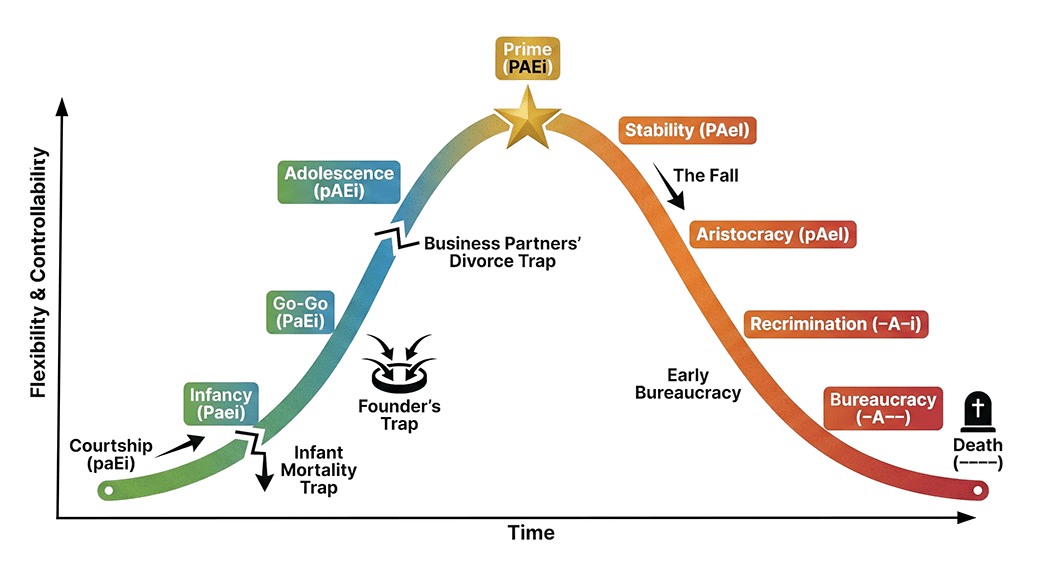
Adizes uses a symbolic shorthand of uppercase and lowercase letters to illustrate the relative strength, presence, or deficiency of each management style during different stages of an organization's life.
The PAEI Shorthand System
Adizes uses this notation to describe the "genetic makeup" of a leader or an organization's culture at a specific moment:
- Capital Letter (e.g., P): Indicates that the role is being performed effectively and is a dominant characteristic.
- Lowercase Letter (e.g., p): Indicates that the role is being performed at a "threshold" or minimum functional level.
- Dash/Zero (e.g., - or 0): Indicates a total deficiency or "blank" in that specific role, which often leads to predictable organizational pathologies.
As an organization moves through its lifecycle, the combination of these letters shifts. For example:
Stage | PAEI Code | Description |
|---|---|---|
Courtship | ---E | High ideas and excitement (Entrepreneur), but no results or systems yet. |
Infancy | P--- | Pure focus on results and "making it happen" (Producer). |
Go-Go | Pa-E | High production and vision, but administration is usually ignored or weak. |
Prime | PAEI | The ideal state where all four functions are operating at high capacity. |
Bureaucracy | -A-- | The "Producer," "Entrepreneur," and "Integrator" have left; only the "Administrator" remains. |
Every workforce is made up of people whose natural aptitudes lean toward one or more of these functions. You might be wondering whether these letters indicate a specific percentage of a workforce or an individual's tendencies. Adizes argues that management is a dynamic process, not a static calculation. Using percentages would imply a level of mathematical precision that doesn't exist in human behavior or corporate culture.
By using the letter notation, he emphasizes the balance and tension between the roles. For instance, too much A (Administration) can stifle E (Entrepreneurship), regardless of the "percentage" of time spent on them.
The Prime Organization (PAEI)
In Adizes’ framework, reaching Prime is the ultimate goal—it is the point where an organization is both flexible and controllable. However, the transition from Prime into the first stages of aging is subtle.
In this stage, the organization has achieved a rare balance. It knows what it is doing, why it is doing it, and it has the discipline to execute.
- P (Producing): The organization is highly effective; it delivers results and satisfies customer needs.
- A (Administering): Systems and processes are in place, but they exist to support production, not to hinder it.
- E (Entrepreneuring): The company is still creative. It continues to innovate and take calculated risks to ensure future growth.
- I (Integrating): There is a strong, shared culture. People work together toward a common vision, and internal politics are kept to a minimum.
An organization at Prime is a "work hard, play hard" environment where people feel empowered. The organization is growing, profitable, and focused.
As an organization begins to age and drift away from Prime, it often enters a state Adizes calls "The Fall". The most significant change is the loss of the lowercase letters e and i becoming "tired."
- P (Producing): The company is still making money and delivering products. To the outside world, everything looks great.
- A (Administering): The "A" remains strong (or even grows stronger). There is a process for everything.
- e (Lower-case Entrepreneuring): This is the critical decline. The "spirit" of innovation starts to fade. The organization becomes more interested in how things are done than why. It stops taking risks and starts focusing on protecting its current market share.
- i (Lower-case Integrating): The shared sense of mission begins to erode. People start looking out for their own departments or careers rather than the whole company.
The organization is still successful, but it is becoming "stiff." There is a subtle shift from a "we can" attitude to a "we should" or "we've always done it this way" attitude. The focus moves from external (the customer) to internal (the hierarchy).
In short, PAei is the beginning of the end of the growth cycle. If the E and I aren't revitalized, the organization will eventually slide into The Aristocracy phase, where it is all form and very little substance.
The difference between PAEI and PAei is essentially the difference between a "winning athlete in their peak" and a "winning athlete who has started to prioritize their trophies over their training."
Where am I Going With This?
Here’s why this matters: AI is fundamentally a Producer and an Administrator. That is what it does exceptionally well. It executes tasks brilliantly. It organizes information, tracks processes, and maintains systems without getting tired or forgetting steps. The efficiency gains are real and significant.
But AI struggles with Entrepreneurship. It can generate options based on patterns in existing data, but it cannot truly see what does not yet exist. It can compute probabilities, but it cannot feel the weight of what is at stake. It can't challenge assumptions from a place of conviction born from lived experience.
AI doesn't bear consequences in the way humans do. It has no body that can be harmed, no reputation that can be ruined, no family depending on its income, no career that rises or falls. When entrepreneurs risk their savings on a venture, they feel something. They lose sleep. They feel the weight. That felt experience of consequence shapes judgment in ways that pure probability calculation does not.
AI struggles even more with Integration. It can't build genuine consensus among people. Consensus is not the same as agreement. It is the felt sense that your voice was heard, your concerns were weighed, and even if the final decision was not your first choice, you have ownership of it. That requires the other party to genuinely care about you as a person, not just process your input as data. AI cannot read the room either. Reading the room means sensing the pause that lasts a half-second too long, the shift in posture, the glance exchanged between two people who have history. These are embodied perceptions, gathered through years of navigating social situations where misreading them had real consequences.
AI can't hold a team together through trust and shared purpose. Trust is earned over time, through moments when someone acted with integrity even when it cost them something. You trust a colleague because you watched them take the blame when they could have deflected, or speak up when staying silent would have been easier. AI doesn't sacrifice. It does not choose when choosing is hard. And without that, it can't be the glue that holds people together.
The Dehumanizing Power of "Humans"
I also want to call out the language that dominates conversations around AI. The phrasing always centers around things like “humans,” "human labor," "human capital," “human-in-the-loop,” and "humans versus machines."
But nobody talks this way about their own life. No business leader says, "My company employs 60 humans." No father says, "I'm going to take my humans to Disney World this summer." No teenager says “I’m going outside to play football with the humans next door.”
The word “human” creates psychological distance. It turns people into a category, a variable in an economic equation. And once people become "humans" in the abstract, it becomes easier to talk about replacing them. And it subconsciously makes someone think they’re talking about something else or someone else… “They’re certainly not talking about me.”
So let's reframe this conversation around what actually matters: people.
Replacement Versus Amplification
The dominant narrative sees AI as a replacement for human labor (see what I did there?). If AI can do the work faster and cheaper, why pay people to do it? This logic leads inevitably to the bleak futures that Amodei describes: mass displacement, extreme inequality, and a workforce left behind. If we focus on the labor component as the sole contribution of an individual, then this view makes total sense.
But there is another way to think about this.
Consider a person whose natural aptitude is Production. They are a doer, a maker, someone who thrives on output. Today, that person might produce ten reports per week. With AI handling execution, that same person could orchestrate the production of 100 reports per week. They would apply their judgment to what matters, catch errors the AI misses, and decide which insights deserve deeper investigation.
They have not been replaced. They've been promoted from "producer" to "production architect."
Consider a person whose natural aptitude is Administration. They thrive on order, systems, and consistency. They design workflows, develop rules and guidelines, engineer the monitoring system and protocols, ensure order is maintained, and optimize processes when adjustments are needed. Today, they might manually track fifty compliance items. With AI handling the routine monitoring, that same person could govern systems that track 500 items. They would design the logic that ensures nothing falls through the cracks and intervene only when personal judgment is required.
They haven't been replaced either. They have moved from "administrator" to "systems governor."
This is amplification, not replacement. The person's identity stays intact. The hard worker remains a hard worker. They just work on different things at a different scale.
What Becomes Possible
Here is where the real opportunity opens.
Even people whose natural aptitude is Production or Administration have some latent capacity for Entrepreneurship and Integration. That capacity has been suppressed because their days were consumed with execution and organization. A factory supervisor might have creative ideas about redesigning the production line, but they never have time to explore them because they are putting out fires all day. A compliance officer might have genuine insight about building a healthier team culture, but they are buried in checklists.
AI doesn’t magically transform a Producer into an Entrepreneur. But it might give them the breathing room to exercise the 15% of their aptitude that has been dormant. And when you unlock that potential across an entire workforce, the aggregate effect could be substantial.
The people who were hired to do the work can now contribute to shaping what work should be done. The people who were hired to organize can now contribute to building the culture that holds everything together.
The economic potential of a workforce operating this way isn't diminished. It is expanded.
The Embodied Advantage
There’s a deeper reason why AI can't fully replace Entrepreneurship and Integration that comes from a lived experience. These capacities are rooted in embodiment. They emerge from being a person who exists in physical space with other people.
Entrepreneurs often talk about gut instinct, a felt sense that something is worth pursuing even when the data is ambiguous. Integrators talk about reading the room, sensing tension or alignment through cues that are difficult to articulate. These are not purely cognitive processes. They emerge from an individual who has lived through consequences, felt the weight of decisions, and developed intuition through experience.
People enjoy food with their taste buds. They smell, feel textures, and sense temperature. They experience the visceral thrill of watching a football game with friends, the awkward silence of a difficult conversation, and the warmth of genuine connection. These embodied experiences shape judgment in ways that cannot be replicated by pattern matching on text.
A robot might someday be built that can identify flavors. But could it create a new dish that delights the patrons of a fine restaurant? Creativity is an expression filtered through a lived existence that AI does not have.
This isn't a limitation that will be overcome with more compute or better algorithms. It's a categorical difference between entities that inhabit physical reality and entities that process representations of it.
The Training That Nobody Is Doing
If amplification rather than replacement is the path forward, then everything changes about how we should be training the workforce.
Most AI training teaches people how to use tools. Write a prompt, get an output. Generate content, automate tasks. This is useful but insufficient. It treats AI as a vending machine: put in a query, get out a result.
What people actually need to learn is how to think and work in partnership with AI. This requires skills that most people have never been explicitly taught.
The ability to hold a provisional idea loosely enough that it can be shaped by another perspective. The willingness to be challenged without becoming defensive, and the capacity to recognize when a conversation is generative versus when it is going in circles. Not to mention, the judgment to know when to follow a thread and when to redirect.
These are Entrepreneurial and Integration skills. They have nothing to do with mastering technology. They are about how people think and how people work together. AI just happens to be the reason they matter more now than ever.
For this kind of training to work, organizations need to start with an assessment. They need to understand what each person's dominant traits are, and then push them into a curriculum specifically designed to capitalize on that aptitude.
A Production-dominant person needs training on how to move from doing the work to orchestrating work at scale. How do you maintain quality standards when you're overseeing AI outputs rather than producing yourself? How do you exercise judgment about which outputs need revision and which are good enough?
An Administration-dominant person needs training on how to design systems rather than follow them. How do you create the governance architecture that ensures AI operates within appropriate bounds? How do you know when a system needs a person to take over or override?
And everyone needs training on how to develop their latent Entrepreneurial and Integration capacity. How do you recognize when a conversation is opening new possibilities? How do you build on someone else's idea rather than competing with it? How do you hold space for ambiguity long enough for something new to emerge?
These are very different curricula. They require assessments that identify aptitudes and programs that meet people where they are. Nothing like this exists at scale today.
A Framework Already in Motion
This vision isn't purely theoretical. At INGRAIN AI, we have spent years building frameworks that operationalize these ideas, and we are continuing to develop them as the technology evolves.
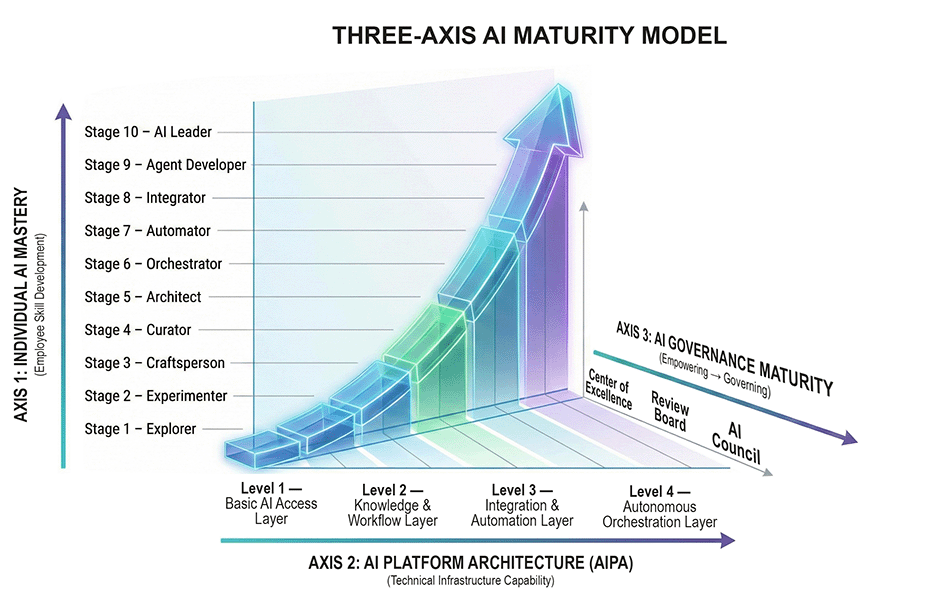
Our 10 Stages of AI Mastery maps how individuals advance from basic AI tool use toward true orchestration. In the early stages, people learn foundational skills: how to interact with AI effectively, how to evaluate outputs, how to organize their own work in ways that AI can leverage. These stages are prerequisites for everything that follows, because you cannot delegate to an AI system if you can't articulate what you need done, in what order, with what priorities.
In later stages, the focus shifts from using AI to leading it. Professionals learn to build custom agents, design workflows that combine human judgment with AI execution, and eventually allocate work across human and AI contributors based on what each does best. The skills learned in early stages become the management layer for the AI systems they will oversee later. The progression is deliberate: each stage builds capabilities that the next stage requires.
Parallel to individual development, organizations need a way to assess their collective readiness. Our maturity model measures three axes: AI capability, governance infrastructure, and workforce preparedness. Most organizations focus only on the first axis, acquiring AI tools and technical capability. They neglect the governance structures that ensure responsible use and the workforce development that ensures effective use. All three must advance together, or the organization creates gaps that undermine its investment.
What makes this approach different from typical AI training is our integration of aptitude assessment. Before pushing someone through a curriculum, we identify their dominant traits using frameworks like the PAEI model. A Production-dominant person will follow a different path than an Integration-dominant person. The training is being designed to meet people where they are and amplify what they already do well, rather than forcing everyone through identical content.
We are actively developing how these aptitude-based pathways integrate with each stage of mastery, refining the approach as we learn what works in practice.
My hope is that others will read this and begin developing similar approaches. The challenge is too large and too urgent for any single organization to address alone. Business schools, corporate training departments, and workforce development organizations all have roles to play.
The more practitioners working on this problem, the faster we will develop the methods that the moment demands.
A Message to Business Leaders
You're reading headlines about AI replacing workers and seeing forecasts of mass displacement. You may be feeling pressure to cut costs by automating roles. And you may also be feeling uneasy because you know that many of those roles are held by people you have worked with for years.
Especially in small and medium-sized businesses, the workforce is a family. There's connection, history, trust built over time. One of the hardest things a leader can do is fire someone, knowing that decision affects their life, their family, and their sense of worth. That empathy, that felt weight of consequence, is something AI will never have.
Here is the opportunity.
You could be the leader who sees past the replacement narrative. You could invest in training that amplifies your people rather than discarding them. Your workforce could become dominant because you unlocked capabilities that competitors left dormant. Your company could thrive because you saw something others missed.
Frameworks for this kind of training exist now. The organizations that adopt them early will have a significant head start over those who wait for the approach to become mainstream.
You may feel behind on AI because people three levels below you seem to understand it better. That's fine. Your role is not to master the technology. Your role is to shape the strategy for how your organization uses it. And the strategy that treats AI as a tool to amplify the contributions of individuals is one that plays to your strengths: judgment, relationships, and the ability to see what your people could become.
A Message to Higher Education
The academic world is rapidly facing a day of reckoning. For years, the dominant response to AI has been to see it as cheating. Students using AI to write papers are violating academic integrity. The goal is to test what the student knows without assistance.
This framing misses the point entirely. AI gives everyone access to humanity's accumulated knowledge in a millisecond. It's not going away. The question is not how to prevent students from using it. The question is how to prepare students for a world where using it well is a core professional skill.
If universities continue to treat AI as a threat to be contained, they'll become irrelevant. The education they provide will be disconnected from the reality their graduates will face. Students and employers will notice, and enrollment will suffer.
The curriculum needs to change. Not just adding courses on AI tools, but fundamentally rethinking what skills matter when AI handles production and administration. Critical thinking, collaborative cognition, creative synthesis, ethical judgment, the ability to formulate intent clearly enough that AI can work with it. These are the skills that will define professional success. They are barely taught today.
Universities are not known for moving quickly. But the window for adaptation is shorter than anyone wants to admit. Institutions that change their approach will attract the students who understand what is coming. Institutions that cling to old paradigms will find themselves training people for a world that no longer exists.
What We Control
The existential risks Amodei describes, the bioweapons, the autonomous weapons, the AI-enabled totalitarianism, are real. But they are largely beyond the control of business leaders and educators. Geopolitics will unfold as it unfolds. The genie is out of the bottle, and there is no putting it back.
What is within your control is how you prepare your people for what is coming. How you train them. How you assess their aptitudes and develop their latent capacities. How you position AI as a partner rather than a replacement.
The organizations that get this right will not just survive the transition. They will define what comes next.
Their workforces will be healthier, more creative, more resilient. Their people will find meaning in work that amplifies rather than diminishes them, and their cultures will hold together because they invested in the human capacities that AI cannot replicate.
This is the path forward. The future of work is not written yet. The choices we make now, about training, about assessment, about what we value in people, will shape what that future becomes.
This conversation has been dominated by fear. It's time to talk about what we can build.
John Munsell is the co-founder and CEO of Bizzuka and a recognized authority on artificial intelligence strategy, implementation, and execution. John is the author of INGRAIN AI: Strategy through Execution. He is also the creator of the AI Strategy Canvas® and Scalable Prompt Engineering™, frameworks used by business leaders and academic institutions to scale AI effectively across organizations.