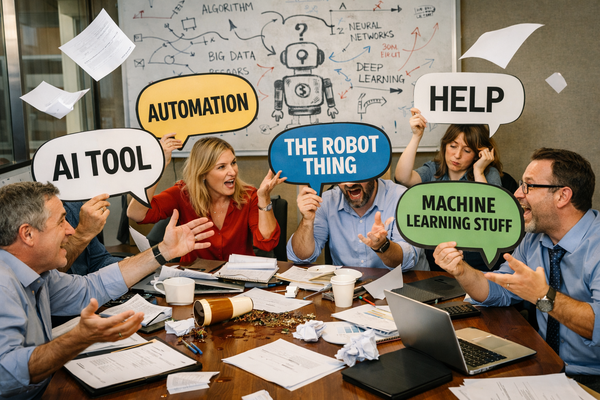
Right now, somewhere in your building or across your Slack channels, your marketing team is generating content with one AI tool, your sales team is waiting for someone else to tell them where to start, and your IT department is quietly sweating through a growing list of unauthorized subscriptions it didn't approve and can't monitor.
Everyone is doing something with AI. Nobody is doing the same thing.
That disconnect is a language problem, and it’s costing you more than you realize.
According to a 2023 survey by Boston Consulting Group covering more than 12,800 employees across 18 countries, only 14% of frontline employees have gone through any AI upskilling training, compared with 44% of leaders. Meanwhile, the 2024 Microsoft and LinkedIn Work Trend Index found that 75% of knowledge workers have tried or use AI at work, and 78% of those AI users are bringing their own tools to the office, often without approval, oversight, or any consistent standards.
The result is a patchwork of competing approaches, duplicated effort, and zero ability to scale what’s actually working.
Think about what that looks like from inside your organization:
Sales is excited about using AI for appointment setting, but they can’t describe what they need
Customer service is working with an outside developer to build an AI automation, but neither side knows enough about the other's world to even draft the design specs
Your executives are trying to make strategic AI decisions while the people executing those decisions are still figuring out which tool to open.
Everyone is speaking a different dialect of the same language.
And here’s the really hard part: when your teams can’t communicate clearly about AI, they can’t collaborate effectively around it. And when they can’t collaborate, they can’t scale it, and your competitors who figured this out first will leave you behind.
The good news is that this problem is entirely solvable, and it doesn’t require a bigger budget, a new hire, or another SaaS subscription. Just a shared framework.
Why Your Teams Are Speaking Different AI Dialects
The Communication Breakdown That's Killing AI Adoption Before It Even Starts
Your departments aren’t speaking the same AI language.
Think about what that actually looks like in practice. Your sales team calls AI a "prospecting assistant." Marketing thinks of it as a "content tool." Your operations manager sees it as "automation." IT is worried about "governance and security," and your CEO just wants to know why the tools you're paying for aren't delivering on the promise yet.
When your people can't describe what they need from AI in terms others understand, one of two things happens: either the initiative stalls because nobody can align on scope, or it lurches forward with everyone pulling in a different direction, producing inconsistent results nobody can build on or repeat.
When Everyone Operates in Isolation, No One Wins
The damage goes deeper than a few miscommunications. Working in AI silos, teams duplicate effort constantly. The prompt your marketing team spent 3 hours refining last quarter? Your sales team is trying to build the same thing from scratch this week, with no idea the work already exists. The automation your operations team just figured out? Customer service could have used it 6 months ago, but nobody shared what was working.
Knowledge that should compound across your organization just vanishes into departmental voids.
A confidence problem follows close behind. Without a shared framework for thinking and talking about AI, people feel exposed in cross-functional conversations. They hesitate to suggest improvements or flag concerns because they're afraid of sounding uninformed. That silence is expensive. Problems linger longer than they should, and opportunities never get surfaced at all.
The reality is that you can't build shared momentum around a tool nobody's describing the same way. Before your organization can collaborate effectively around AI and scale what's working, or align strategy with execution, every team needs a common language. One that works in the boardroom, in a planning session, and on the front line.
What a Shared AI Language Actually Looks Like
A shared AI language goes far beyond a vocabulary list. It's a shared way of thinking about AI, one that every person in your organization can use to plan, discuss, and execute AI initiatives without confusion, friction, and reinventing the wheel every single time.
Here's the distinction that matters: a vocabulary list tells people what words to use, and a shared framework tells people how to structure their thinking. One produces better conversations. The other produces better outcomes.
The Difference Between Talking About AI and Thinking in AI
Consider what happens inside most organizations without a shared framework. A department head walks into a planning meeting with an AI idea. She can articulate the outcome she wants, but she's fuzzy on who the initiative is actually serving, what constraints the legal team needs to know about, what resources IT will need, and how success gets measured. The conversation spirals. People talk past each other. Hours get burned and nothing gets decided.
Now picture a different kind of meeting: everyone around the table is working from the same structured framework. One person clarifies the target audience. Another fills in the company context. A third identifies the rules and constraints. Someone else defines the request. Within an hour, the team has a complete, shared picture of the initiative, and everyone leaves knowing exactly what to do next.
The framework didn't make those people smarter. It gave them a common structure to think inside of together.
Shared language creates the foundation your entire organization needs to align on AI's role and potential. "This means everyone from the C-suite to front-line employees uses the same frameworks and terminology to discuss, implement, and evaluate AI initiatives." Without that foundation, even the best AI tools in the world can't deliver consistent, scalable results.
What Shared Language Actually Does for Your Organization
A genuine shared AI language does four things that no training program can replicate on its own.
First, it gives people peripheral vision. One of the most damaging patterns in organizations is when employees only see the task directly in front of them, completely disconnected from how their work affects other departments. A shared framework changes that. When everyone uses the same structure to think about AI, they naturally start to see how each piece connects to the whole.
Second, it connects technical and non-technical teams. Your IT department and your marketing team aren't going to start speaking the same native language overnight. A shared framework gives them a neutral third language, one that neither side owns and both sides can use to build toward the same outcome.
Third, it creates shared metrics. When your teams are thinking about AI initiatives through the same lens, they can measure results in ways that actually mean something across departments.
Fourth, and perhaps most powerfully, it builds confidence. People who feel uncertain about AI don't raise their hands. They stay quiet in meetings, they avoid suggesting process improvements, and they let better ideas die in their heads. When your team has a clear framework to think inside of, that fear drops away. They know how to contribute. And when people feel confident, they participate, and that participation accelerates everything.
How the AI Strategy Canvas Becomes Your Organization's Rosetta Stone
Every organization struggling with AI adoption has the same invisible problem: each department brings its own lens, priorities, and vocabulary to every AI conversation. The CMO wants conversion rates and the CRO wants product visibility. IT wants to lock down anything unfamiliar. Your CEO wants search dominance. And somewhere in the back of the room, one person quietly knows AI could solve most of this, but nobody has a structure for that conversation.
The AI Strategy Canvas® was built for exactly that moment. It gives your entire organization a single, structured framework for discussing, planning, and executing AI initiatives.
What the 9 Blocks Actually Do
Think of the canvas like a financial ledger. On one side, you're capturing what generates value: your Target Audience, your Company, and your Products and Services. These are the blocks that define who your AI serves, what your organization stands for, and what specific value you deliver. On the other side, you're refining that value through Role, Style and Brand Voice, and Resources, the blocks that shape how your AI thinks, communicates, and operates.
At the bottom sit Rules and Request, your control and execution levers. Rules keep your AI operating within appropriate ethical, legal, and brand boundaries. Request is where all the preparation comes together into a clear, specific instruction that delivers results the first time rather than the fifth.
Holding everything together at the center is Context, the block that ties every other element to your actual business reality.
The canvas forces you to consider every factor that impacts your AI decisions, whether someone's in the room or not. It's the ultimate checklist that turns random discussions into clear, actionable plans.
Three Ways Your Organization Will Use It
The canvas works at every level of your organization, and it does so in 3 distinct stages.
Your leadership team uses it first to facilitate AI strategy discussions. The 9 blocks give executives a structured process for thinking through every aspect of an AI vision, from defining who benefits to identifying what resources are required. Conversations that used to spiral into confusion become focused and productive.
Cross-functional teams use it next to plan AI initiatives together. Picture implementing an AI-powered onboarding system. HR needs to define the audience. Legal needs to set the rules. IT needs to identify the resources. Marketing needs to calibrate the brand voice. The canvas gives every department a specific role in the conversation and a clear place to contribute, so nothing gets missed and nobody talks past each other.
Finally, every team member who uses AI tools directly uses the canvas to build better prompts. When your people learn to structure their AI interactions around the nine blocks, they stop producing inconsistent, hit-or-miss outputs. They start producing prompts that can be shared, adapted, and scaled across departments, turning individual wins into organizational knowledge.
Establishing shared language through the canvas changes how your entire organization thinks about and implements AI. Suddenly, cross-departmental collaboration becomes natural, and AI initiatives get launched seamlessly and completely aligned with your strategic vision.
You don't need to overhaul your entire operation to get there. You just need to start with the right foundation. Download your free copy of the AI Strategy Canvas and bring it to your next planning meeting. See what changes when everyone in the room is finally speaking the same language.