You’ve probably seen this happen right after AI training ends.
The room was engaged. The ideas felt practical. People could picture faster work, better content, and sharper decisions. Then the week filled up. Meetings took over, deadlines got louder, and old habits slipped back in and pushed the new ones out.
That’s the turning point.
Some teams lose momentum because nobody owns the next step. Others lose it because using AI still feels awkward in the rush of a normal day. A leader tries it once, gets a weak result, and moves on. A marketer gets one solid draft, then can’t repeat the process with confidence. Someone opens the tool, stares at the prompt box, and closes it because they don’t know where to begin.
It adds up fast:
- Usage gets spotty and confidence starts to crack
- The people who were excited a week ago begin to hesitate
- Work still feels heavier than it should
- Content still takes too long
- Research still drags
- Small tasks still eat hours that should’ve gone to strategy, creativity, or growth
Worst, the frustration is quiet.
Nobody wants to admit the training didn’t stick. Most people still believe AI matters. They just haven’t turned that belief into a rhythm they can trust. Without that rhythm, the new skill feels slippery, optional, and like one more thing to figure out when the day is already packed and pulling in ten directions at once.
That’s why this moment matters so much.
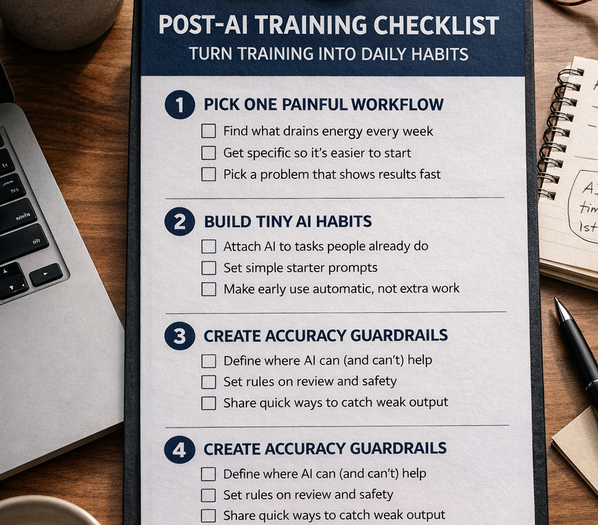
Finishing the training isn’t the win, making the lessons stick is. Building small, repeatable actions into the workday is what creates real change. Once those actions become habits, AI starts feeling useful. This post-AI training checklist is built for exactly that.
Pick One Painful Workflow First
Trying to apply AI everywhere at once is one of the fastest ways to lose momentum.
Most teams leave training feeling fired up. That energy is real, but it can also scatter your focus. When everything looks like a possible use case, nothing gets the attention it needs. People test random prompts, get mixed results, and start wondering whether AI is actually helping. That’s why your first move matters so much. You need one workflow that’s annoying enough to fix and common enough to improve often.
Use this checklist to choose it.
- Find the task that drains energy every week - Look for work that feels repetitive, slow, or mentally irritating. Think first drafts, campaign planning, content repurposing, research summaries, meeting recaps, email variations, or reporting prep. The right starting point usually makes people sigh before they even begin
- Choose a workflow with clear boundaries - Start with something specific. “Use AI for marketing” is too broad. “Use AI to draft LinkedIn posts from webinar transcripts” is far easier to test, refine, and repeat. Narrow focus creates faster wins.
- Pick a problem that shows results quickly - Your first AI habit should save time, reduce friction, or improve output within days, not months. Early proof builds confidence. Confidence keeps the habit alive when schedules get tight.
- Tie the workflow to a real business outcome - Make sure the task connects to something that matters: speed, consistency, pipeline support, campaign output, team capacity, or decision quality. People stick with habits when they can see the payoff.
- Define what better looks like before you begin - Set a simple success marker. That could be cutting draft time in half, reducing blank page stress, creating three usable ideas faster, or shortening research time by 30 minutes. Vague goals create vague results.
- Test one workflow until it feels natural - Don’t rush to stack five more use cases on top of it. Repetition is where the real shift happens. Once one painful workflow feels easier, your team stops seeing AI as a novelty and starts seeing it as part of the job.
Build Tiny AI Habits Into the Workday
Big intentions don’t survive busy calendars. Small habits do.
That’s where many teams get stuck after training. They assume adoption will happen because people now understand the tools. It usually doesn’t work that way. Knowledge matters, but habits are what carry that knowledge into a normal Tuesday when deadlines are tight and attention is split. If AI still feels like a separate activity, people won’t use it consistently. If it becomes part of tasks they already do, it starts to stick.
Use this checklist to make that shift happen.
- Attach AI to work that already happens every day - Don’t ask your team to invent extra practice time. Connect AI to tasks that are already on the calendar: drafting emails, summarizing calls, building content ideas, outlining blogs, rewriting copy, organizing notes, or pulling insights from research. A habit lasts longer when it fits inside existing work.
- Create one repeatable starting prompt for each core task - Blank screens kill momentum. Build a short starter prompt for the workflow you chose in the last step. Keep it simple, clear, and easy to reuse. Once someone can start in seconds, resistance drops fast.
- Set a trigger that tells people when to use AI - Habits stick better when there’s a cue. That cue could be the start of a content draft, the end of a client call, the first step in campaign planning, or the moment research begins. When the trigger is obvious, usage becomes more automatic.
- Keep the first use case small enough to repeat often - Daily or near daily repetition matters more than complexity. A tiny habit used 4 times a week will beat a bigger process used once a month. Frequency builds familiarity. Familiarity builds trust.
- Save strong outputs and prompts in one easy place - People shouldn’t have to reinvent good work. Create a shared folder, swipe file, or prompt library where your team can store what worked. That simple habit cuts friction and keeps progress from getting lost.
- Treat early use like practice, not performance - Some outputs will be rough. That’s normal. What matters most at this stage is repetition. The goal is to help people build rhythm, not chase perfection on every attempt. Once the rhythm is there, quality gets easier to improve.
Create Guardrails So Confidence Doesn’t Collapse
New habits fall apart when people feel exposed.
That happens more often than most leaders expect. A team member gets a shaky result, worries they did it wrong, and backs away. Someone else wonders what data is safe to paste into a tool, so they stop using it altogether. A marketer gets decent output, but doesn’t know whether it’s accurate enough to publish. Once uncertainty creeps in, usage drops. People need clear guardrails that make action feel safe, repeatable, and worth the effort.
Use this checklist to build that safety.
- Spell out what AI can help with right now - Give your team a short list of approved use cases. Keep it practical. Think drafting content, summarizing research, organizing notes, brainstorming angles, rewriting copy, or building outlines. Clear permission removes hesitation.
- Define what should never go into a prompt - This is where trust gets protected. Be direct about sensitive data, client information, private business details, financial records, or anything confidential. When boundaries are obvious, people don’t have to guess.
- Set a simple review standard for AI assisted work - Nobody should assume the first output is ready to ship. Create a rule that says every draft gets reviewed for accuracy, brand fit, tone, and relevance. That one habit reduces risk and improves quality fast.
- Give people a quality check they can use in under a minute - Keep it short: Is it accurate? Is it useful? Does it sound like us? Does it need proof, examples, or cleanup? Quick filters help people move forward without feeling buried in process.
- Decide who owns the final decision - AI can support the work, but people still need accountability. Make it clear who approves copy, who validates facts, and who signs off on anything customer-facing. Ownership keeps confusion from spreading.
- Document what works so confidence can grow - When a prompt produces a strong result, save it. When a process leads to cleaner output, write it down. Small documentation creates stability. Stability helps the team stop relying on memory and start building a system they can trust.
- Normalize correction instead of punishing rough first tries - People won’t keep using AI if every imperfect result feels embarrassing. Early mistakes should be treated as part of learning. A team that can refine without fear will improve much faster than one that shuts down after one weak attempt.
Make Success Visible So the Habit Spreads
People keep using what they can see working.
That sounds simple, but this is where AI adoption either hardens into a real habit or fades into scattered personal use. If wins stay hidden, momentum stays fragile. One person saves time. Another gets better output. A third finds a smarter way to prep for meetings. None of it changes the team unless those results become visible, repeatable, and easy to talk about. When progress is seen, belief grows, and usage spreads.
Use this checklist to make success impossible to ignore.
- Track time saved in plain language - Don’t overcomplicate this. Ask people to note what used to take 90 minutes and now takes 35. Track faster drafts, shorter research cycles, cleaner summaries, and quicker content repurposing. Tangible proof makes AI feel real.
- Collect small wins every week - A single strong example can change how the whole team thinks. Save before and after drafts. Share the prompt that helped unlock a stuck project. Show where AI reduced friction in a task people already hate doing. Visible wins lower skepticism.
- Make useful examples easy to find - Build a shared library with prompts, outputs, lessons, and edits that worked. People adopt faster when they can borrow proven starting points instead of guessing their way through every task.
- Show what better work feels like now - This matters more than most teams realize. Life after AI habits stick looks calmer. Marketers aren’t staring down blank pages with that sinking feeling in their chest. Leaders aren’t watching hours bleed out on work that should’ve moved faster. Teams have more room to think, refine, and make stronger decisions. Pressure doesn’t disappear, but the drag gets lighter.
- Recognize consistency, not just flashy results - The goal is steady use that improves the workweek. Celebrate people who use AI thoughtfully and often. That’s how habits become culture.
- Build on success with structured support - Once the team sees what’s working, the next step is easier. That’s where guided training and practical support can keep progress from stalling. We help teams turn early traction into lasting adoption through focused AI training that fits real workflows, real pressure, and real business goals.
When people choose one painful workflow, build small habits around it, use clear guardrails, and make wins visible, AI becomes part of the rhythm. Work gets faster. Friction eases. Confidence grows.
For business leaders and marketers, that shift matters more than most people realize. It means fewer stalled projects, blank page battles, and hours lost to repetitive work that drains focus. In its place, you get a team that moves with more clarity, more consistency, and more control.
That kind of change doesn’t usually happen from inspiration alone. It sticks when the training is practical, the next steps are clear, and the habits connect to real work people already need to do.
That’s where Bizzuka can help. Our AI training programs are built to help teams move past the early excitement and into steady, useful adoption, so the skills learned in training show up in content, marketing, decision making, and daily execution.