Your company can buy the tools, train the team, launch the pilots, and still have painfully little to show for it
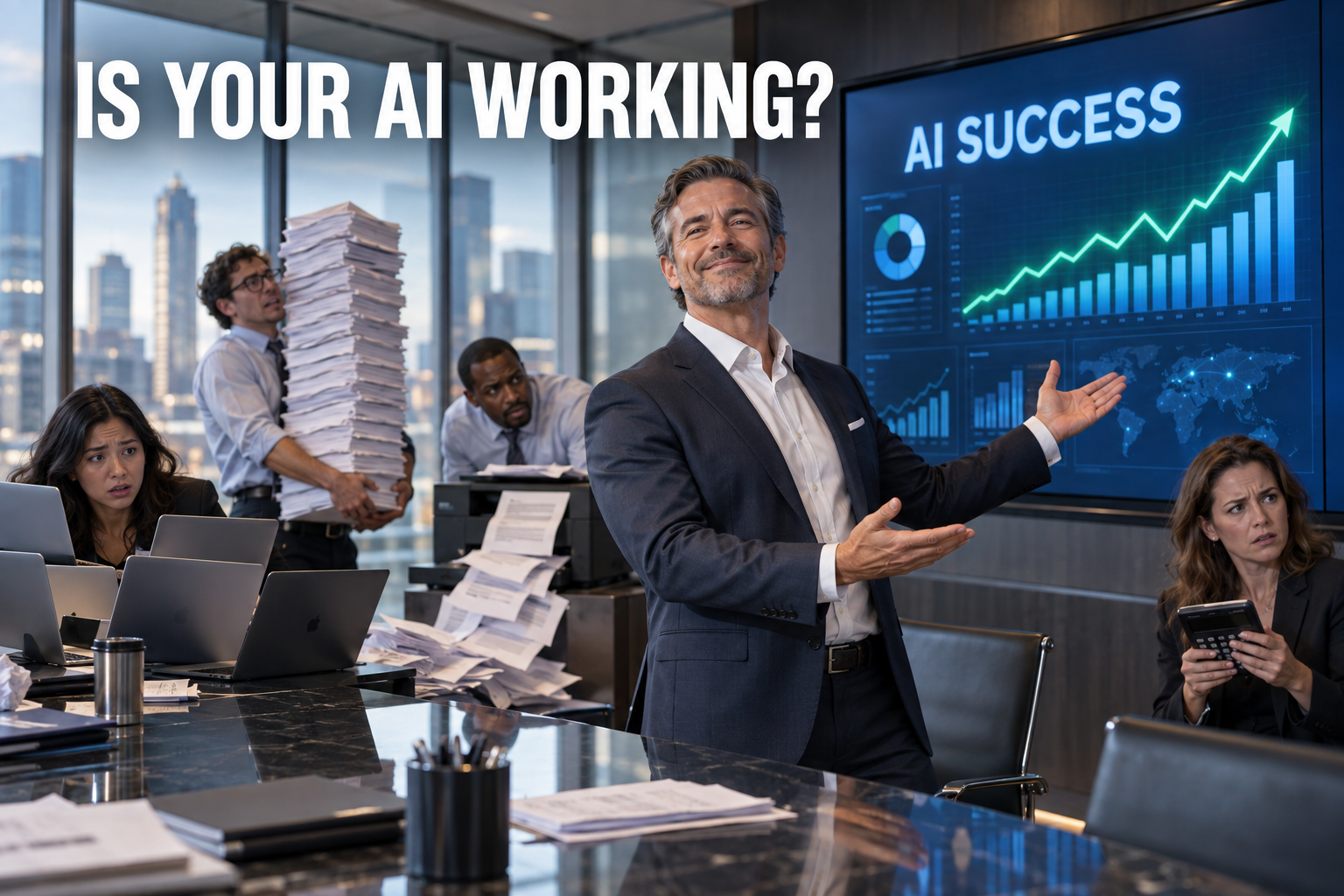
Your AI strategy may look healthier from the conference room than it does inside the business.
The licenses are purchased, employees are using the tools, teams are experimenting, and a few people have built impressive things.
Then someone asks the question that makes the room uncomfortable:
What has AI changed?
How many hours have you recovered? Which processes became faster? Where did costs fall? What new capacity did your people create?
If the answers turn into stories instead of numbers, pay attention. Usage can look like progress without producing much value.
Business leaders need better evidence. These 5 questions will help you find it.
1. Are Your People Using AI or Getting Measurably Better at It?
AI adoption numbers can make a weak strategy look surprisingly healthy.
Employees have accounts. Usage is climbing. Training completion looks good. Teams are experimenting with prompts, summaries, research, and content.
Those numbers tell you AI is being used. They don't tell you whether your people are becoming more capable, which is a much harder standard.
Measure capability instead of clicks
An employee who asks AI to summarize a document is operating at a very different level from someone who can redesign a recurring workflow, build a useful AI assistant, or create a repeatable process that saves hours every week.
Both employees count as AI users.
Their business impact can be dramatically different.
Our INGRAIN AI research separates proficiency into 10 levels across 4 stages: Literacy, Fluency, Mastery, and Ingrained. The research has found that more than 90% of assessed employees begin at Level 2 or below. Meaningful economic impact begins to appear around Level 5.
That changes what leaders should measure. Instead of asking how many people are using AI, look at what they can do with it.
Can they apply AI to real work without someone handing them the answer? Identify tasks worth improving? Build repeatable solutions other employees can use? Show measurable time savings from what they created?
These questions expose capability in a way login counts never will.
Look for evidence inside the work
A stronger AI strategy should leave visible evidence behind.
You should see employees creating useful AI tools, improving processes, documenting successful use cases, and sharing what works with other teams.
And those improvements should recover time.
Our research uses a simple standard called the 3-hour rule. Every trained employee should create a tangible AI artifact connected to their actual job that saves at least three hours per week.
That gives leaders something concrete to measure.
If 500 employees are regularly using AI but only 20 can show how it improved their work, you have an adoption number.
If employees can show what they built, how they use it, and how much time it saves, you have evidence of growing AI proficiency.
Your goal is simple: stop measuring how many people touched AI and start measuring how many people can use it to produce measurable business value.
2. Can You Point to the Hours and Dollars AI Has Recovered?
Sooner or later, AI has to show up in the numbers.
A team might have dozens of successful AI projects. Employees might tell you they are saving time. Managers might share impressive examples in meetings.
But when the CFO asks what those improvements are worth, the conversation can get uncomfortable.
"We're saving a lot of time" isn't a business metric.
Follow the time
Start with something you can measure: hours. Use the 3-hour rule as a practical benchmark.
Employees apply AI to their actual jobs and create something that saves at least three hours per week. Now the impact becomes easier to see.
Three hours per week is 156 hours per employee each year. Across 100 employees, that's 15,600 hours of potential capacity.
And three hours is the starting point.
At Level 7 AI proficiency, our research models 10 recovered hours per week. That's 520 hours per employee annually, or 52,000 hours across 100 people.
Those numbers demand a different conversation.
What happened to those hours?
Turn recovered time into business value
Saving time alone doesn't guarantee financial impact.
If someone finishes a task two hours faster and fills those two hours with low value work, the company hasn't captured much.
Recovered time needs somewhere productive to go.
That might mean serving more customers without adding headcount. It could mean clearing a backlog, shortening production cycles, increasing sales activity, improving quality, or giving skilled employees more capacity for work that directly affects revenue.
This creates a measurement chain leaders can follow: AI application → time recovered → capacity created → business outcome
Take a recurring process that consumes 8 hours every week. An employee uses AI to reduce it to three. That's five hours recovered.
Now track what happens next. Does the team process more work? Does overtime fall? Is turnaround improving? Can the company delay an additional hire? Does someone spend those hours on higher value activity?
That's where AI ROI starts becoming visible.
Your AI strategy should produce evidence you can trace from the employee's work to an outcome the business cares about.
If you can't point to the hours being recovered and explain what those hours are worth, you still have work to do before you can confidently call your AI strategy successful.
3. Are Your Managers Seeing the Same AI Reality You Are?
Executives and managers can work for the same company and have two very different AI experiences.
Executives see the investment, adoption reports, pilot results, and promising use cases. Managers see what happens after the meeting.
Employees struggle to apply AI to actual work. Outputs still require correction. Processes that were supposed to get faster remain painfully slow. Another AI initiative lands on a team already fighting for time.
When those experiences never meet, leadership can believe the AI strategy is working while managers absorb the friction.
Get closer to where the work happens
Middle managers occupy one of the most important positions in an AI strategy.
They understand what leadership expects from AI while seeing what employees can accomplish with it.
That puts managers close to the warning signs.
Maybe employees attended AI training but still don't know how to apply it to their jobs. A promising pilot might work for one person but fall apart when the entire department tries it. Perhaps an AI process saves 30 minutes on one task while creating an hour of review and correction somewhere else.
None of that means AI has failed. It just means leadership needs a clearer view of what's happening inside the work.
Ask the same questions at different levels
Test this inside your own company by asking executives and managers the same questions separately.
Where is AI saving measurable time?
Which workflows have improved?
Where are employees struggling?
Which AI projects have produced measurable business value?
What prevents teams from getting better results?
Now compare the answers.
Perfect agreement isn't necessary. Different roles naturally produce different perspectives.
Large differences, however, deserve attention.
If executives describe rapid progress while managers describe confusion, rework, and weak results, investigate before expanding the investment.
Your managers can show you where an AI strategy is succeeding and where execution is breaking down. Their experience can expose problems that adoption reports and executive presentations miss.
Most importantly, their answers tell you whether AI progress can survive outside a controlled pilot.
A healthy AI strategy should become clearer as you move closer to the work.
4. Is Your AI Investment Building Capability or Buying More Technology?
Buying AI is easy.
Building a workforce that knows what to do with it is much harder.
Yet companies often respond to disappointing AI results by adding another tool, upgrading a platform, launching another pilot, or giving employees access to a more powerful model.
More technology feels like progress because you can see it.
Capability is less obvious.
It shows up when an employee recognizes a task AI can improve, chooses the right tool, gives it useful context, evaluates the output, and turns that work into a repeatable process.
Without those skills, better technology can simply give people more powerful ways to do basic things.
Match the investment to your people
Imagine giving an employee access to an advanced AI system when they're still using AI primarily to rewrite emails and summarize documents.
The technology may be capable of far more, but the employee isn't there yet.
Our INGRAIN AI research describes this as a common investment mistake. Companies pursue sophisticated AI initiatives before developing the workforce capability required to use them effectively. A company can deploy advanced systems and still struggle to produce meaningful business impact when employee proficiency remains low.
That should change how you evaluate the next AI purchase. Before approving another platform, ask what employees can accomplish with the tools they already have.
Are people building repeatable workflows?
Can teams identify valuable AI use cases on their own?
Are successful solutions being shared across departments?
Do employees know how to evaluate AI output instead of accepting it automatically?
Can you connect increased proficiency to recovered time or improved performance?
Those answers tell you whether another technology investment is likely to produce more value.
Make capability visible
Workforce capability shouldn't be treated as something you assume employees will develop through experimentation.
Measure it.
Define what stronger AI proficiency looks like for different roles. Give employees opportunities to apply AI to real business problems. Track the useful processes and tools they create. Then measure whether those applications improve the work.
This also gives leadership a better way to decide where the next AI dollar belongs.
Sometimes the company needs better technology.
Other times, the bigger opportunity is helping employees become skilled enough to use the technology already sitting in front of them.
Before you buy more AI, find out whether your people have outgrown the AI you already own.
5. What Would Change If AI Were Working Across Your Company?
Imagine walking into a leadership meeting and nobody needs to defend the AI investment.
The evidence is already there.
Teams are getting work done faster. Managers can point to processes that have improved. Employees are building useful AI applications for their own jobs. Successful ideas spread beyond the person who created them.
Above all, people are getting time back.
That's what an effective AI strategy should eventually feel like.
When one employee builds something that saves hours every week, coworkers want to know how it works. A useful process can spread across a team. Another department can adapt the idea for its own work.
An AI strategy should leave fingerprints on the business.
You should be able to see them in recovered hours, stronger employee capability, better processes, increased capacity, and measurable financial impact.
If you can't, asking these five questions gives you a place to start.
Look beyond adoption and measure what employees can do. Trace time savings into business outcomes. Listen to what managers experience on the ground. Make sure workforce capability can support your technology investments. Then ask the biggest question of all: what can your company accomplish today that it couldn't accomplish before AI?
The answers may confirm that your strategy is producing real value. They may also expose expensive weaknesses you've been measuring as progress.
Either answer is useful because you can act on it.
Bizzuka's AI Impact Assessment helps business leaders examine where their organization stands today and identify opportunities to produce greater business impact from AI.
If you're investing in AI, don't settle for activity as proof of success.
Take the AI Impact Assessment and find out what your AI investment is producing.