
A full day of demos means nothing if your faculty can't use AI in Monday's lesson. Here's what real capability looks like, and how you'll see it.
Most AI workshops for educators end with high ratings and very little change in the classroom. Teachers leave excited, but weeks later, their lesson plans look the same as before. Some tried a tool once, got a bad result, and gave up. Others are using AI with no guidance at all, and that's a risk you can't afford.
Teachers aren't to blame here. Too many sessions show people what the tools can do, then stop. Few make sure faculty walk out able to do something new on their own.
The Short Answer
After a strong AI workshop, educators should be able to show new skills in their real work.
First, they'll write a clear AI brief for an actual teaching task, such as planning a unit or building a rubric. Each one should also check AI output for accuracy before anything reaches students.
Next comes revision: taking a weak AI draft and improving it with their own expertise. Clear rules for how students may use AI on an assignment belong on the list, too, along with keeping student information out of unapproved tools. Finally, every teacher should be able to explain the human judgment behind the final product.
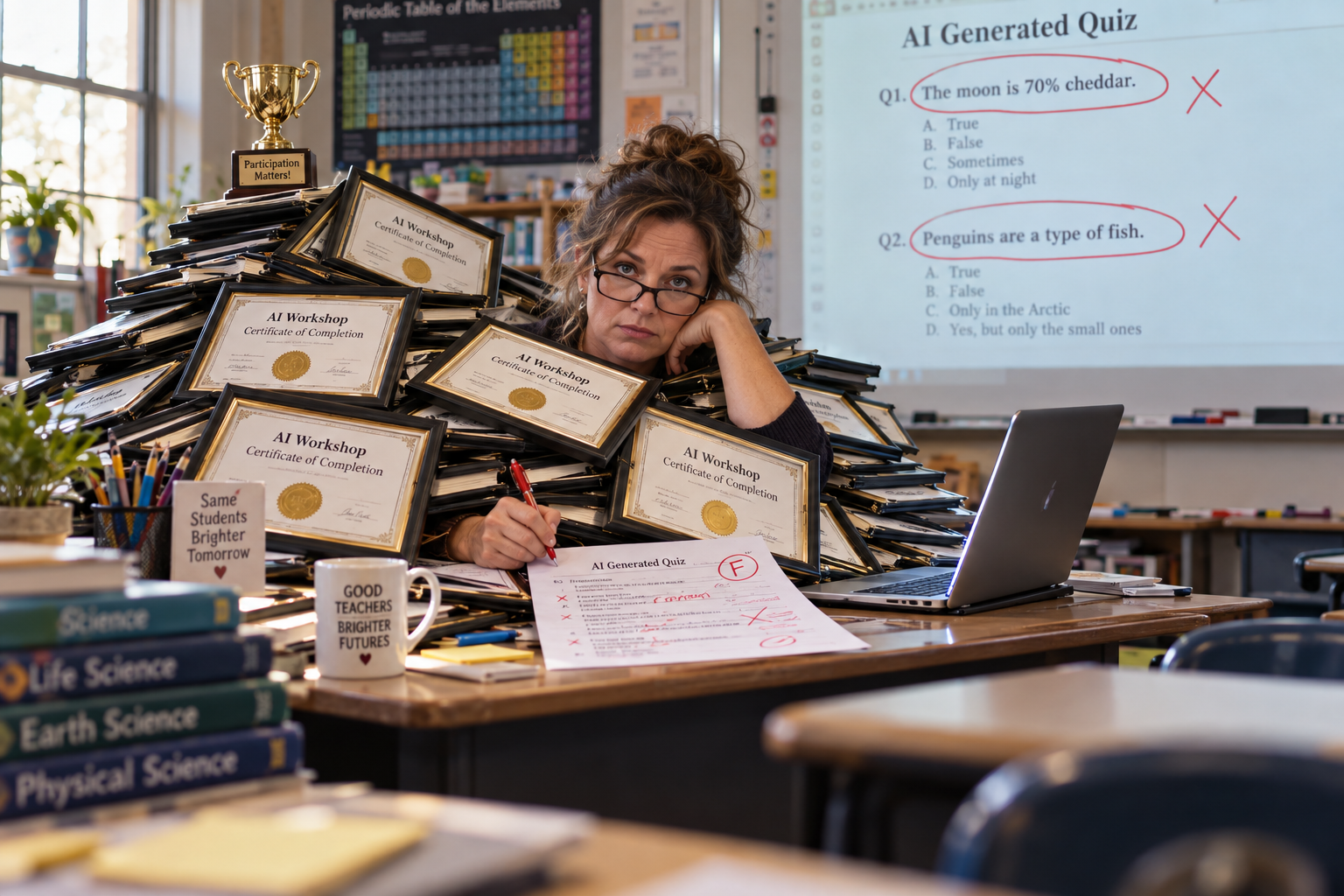
Attendance, hours logged, and certificates don't show any of this. The work does.
If your faculty can't do these things yet, your next training investment has a clear target. Let's look at why the usual measures fall short, what each skill looks like in practice, and how you'll know the learning stuck.
Why Attendance Is the Wrong Measure of AI Training
Full Rooms Only Count Bodies
A packed room feels like a win. Every seat's taken, the exit survey comes back with 4.8 out of 5 stars, and you've got a clean report for your board.
Those numbers can't tell you much, though. They show who showed up and how people felt walking out. They don't show what a teacher can do on a Tuesday night while planning tomorrow's lesson, and that's where training either sticks or disappears.
Certificates carry the same weakness. A teacher who sat through six hours of slides earns the same certificate as one who built a working lesson plan with AI and checked every fact in it. On paper, they're identical. In front of students, they couldn't be further apart.
Excitement Isn't a Skill
Workshops often run on energy. A presenter shows a tool that writes a quiz in seconds, and the room lights up. That spark won't last long on its own.
Once teachers are back in their own classrooms, the hard questions show up:
What do you do when the quiz has two wrong answers?
How do you fix a reading passage that's far above grade level?
If nobody covered that, excitement turns into frustration fast. Multiply that across your whole staff, and you've paid for a great afternoon with very little to show for it.
There's a quieter risk, too. Teachers who keep going without guidance may paste student names, grades, or essays into free tools nobody's vetted. No evaluation form will ever flag that.
Tool Tours Don't Build Habits
Many AI sessions turn into a guided tour of apps. One builds rubrics. Another makes slides. A third drafts parent emails. Teachers leave with a list of logins and no repeatable method for using any of them well.
Tools change every few months. A habit, such as writing a clear brief and reviewing the output before it reaches students, lasts for years. When training centers on the app instead of the habit, your investment expires with the next software update.
Start With the Finish Line
Before you book the next session, ask one question: what should our people be able to show us afterward? If nobody can answer that clearly, the workshop has no finish line.
Six Skills Every Educator Should Walk Away With
1. Write a Clear AI Brief
A vague request gets a vague answer. Asking for "a lesson on fractions" gives AI almost nothing to work with. A strong brief names the learning objective, the grade level, the time available, any constraints, and what a good result should include. Teachers who can write this kind of brief get usable drafts on the first or second try instead of the tenth.
2. Check the Facts Before Students See Them
AI sounds confident even when it's wrong. It can invent quotes, mix up dates, and cite sources that don't exist. Every educator should leave training with a simple habit: verify names, numbers, and citations against a trusted source before anything goes on a handout or slide. If a teacher can't spot a made-up reference, they're not ready to use AI with students.
3. Revise a Weak Draft With Real Expertise
The first draft is rarely the one that belongs in a classroom. Teachers should be able to take an AI lesson outline, find what's missing or wrong, and fix it. Maybe the activities don't match the objective. Maybe the reading level's off, or the examples won't connect with their students. Spotting those problems is where a teacher's training and experience matter most.
4. Set Clear AI Rules for an Assignment
Students need to know exactly where the line sits. They need to know whether they can use AI to brainstorm but not draft, whether they must disclose it, and what they still have to explain on their own. An educator should be able to write these expectations in plain language for a specific assignment, so students aren't left guessing.
5. Keep Student Information Safe
Every teacher should know which tools your institution has approved and which information never goes into them. Student names, grades, IEP details, and personal writing shouldn't land in an unvetted app. This skill doesn't take long to teach, and it protects everyone involved.
6. Explain the Human Decision
AI can suggest. The teacher decides. After a workshop, educators should be able to point to any AI-assisted material and explain what they kept, what they changed, and why. That explanation shows judgment, and judgment is what students and parents are counting on.
How Leaders Can Tell If the Training Worked
Ask to See the Work
The fastest way to judge AI training is to look at what teachers produce. Skip the survey and ask for artifacts. A useful set might include one AI brief, the draft it produced, the revised version, and a short note on what the teacher changed and why.
Those four pieces tell you more than any rating scale. You'll see whether the brief was specific, whether facts got checked, and whether the teacher's own expertise shaped the final product. You'll also see who needs more support before small problems harden into habits.
What Educators Should Show After 30 Days
Give it a month. By then, a teacher who truly learned something should have AI built into at least one regular task, such as weekly lesson prep, rubric building, or parent communication. They should be able to show a written AI expectation for at least one assignment. Most should also be able to walk a colleague through their process in a few minutes.
Treat this as a simple check on whether practice changed, without turning it into a pass or fail test. Teachers who feel judged will hide their struggles, and those struggles are exactly what you need to see.
Signs Practice Has Changed
Logins and hours spent inside a tool won't tell you much. Heavy use can mean someone's struggling, and light use can mean someone found one task where AI really helps. Better signs are easier to spot than you'd think:
Teachers share briefs and prompts with each other without being asked
Department meetings include questions about checking AI output
Assignment sheets start listing clear AI rules for students
Teachers can explain what they rejected from an AI draft, along with what they kept
Signs That the Training Stayed in the Room
Some signals tell you the AI workshop didn't stick. Teachers can name tools but can't describe how they'd use one for a real lesson. AI-generated handouts show up with errors nobody caught. Students ask whether AI is allowed and get different answers from different teachers. Questions about student data come up only after something's already gone wrong.
When you see these signs, don't blame your staff. They're showing you where the training fell short and where your next round of support should focus.
Turning One AI Workshop Into Lasting Teaching Practice
Even a great workshop fades fast without follow-up. Teachers go back to full schedules, grading piles, and parent emails. New skills that don't get used in the first week or two tend to slip away quietly.
That's why the workshop should be the starting point. The real learning happens in the weeks after, when teachers apply what they learned to their own work and hit the problems nobody covered in the session.
Build a One Month Practice Plan
Pick one real preparation task for each teacher, something they do every week. It could be writing exit tickets, building a rubric, or drafting a unit overview. For the next 30 days, they'll use AI on that single task, following the same steps every time: write the brief, check the facts, revise the draft, and note what they changed.
Keeping it to one task matters. It's small enough to fit into a busy week and repeated often enough to become a habit. By the end of the month, teachers have a working process and a stack of real examples to show for it.
Give Teachers Someone to Practice With
Teachers learn faster from each other than from any slide deck. A small peer group of 4-6 people, meeting for 20 minutes every other week, gives them a place to share what worked and what flopped. One person brings a brief. Another brings a draft that went sideways. Everyone leaves with something new to try.
Over time, the best briefs and examples should go into a shared resource library. Keep it simple, organized by subject or grade level, and easy to search. If it takes more than a minute to find something, people won't use it.
Put Clear Guidance in Writing
Teachers can't build good habits on unclear rules. Your institution should spell out which AI tools are approved, what information can and can't go into them, when teachers must review output, and how they should talk with students about AI use. A short guide people read beats a long policy that sits untouched in a shared drive.
Guidance also gives teachers permission to try. When the boundaries are clear, they don't have to wonder whether they're breaking a rule every time they open a tool.
Make Your Next AI Workshop Count
Your faculty don't need another afternoon of tool demos. They need skills they can use on a Tuesday night, habits that hold up after the excitement fades, and clear rules that keep students safe. When training is built around what educators should be able to show afterward, you'll know exactly what your investment bought.
Start by making these six skills your goal for training. Then give teachers a practice plan, a peer group, and written guidance so the learning has room to grow. Ask to see real work after 30 days.
Ready to plan training that changes what happens in your classrooms? Schedule a call to talk through your goals, your faculty's current skill level, and what success should look like for your institution.