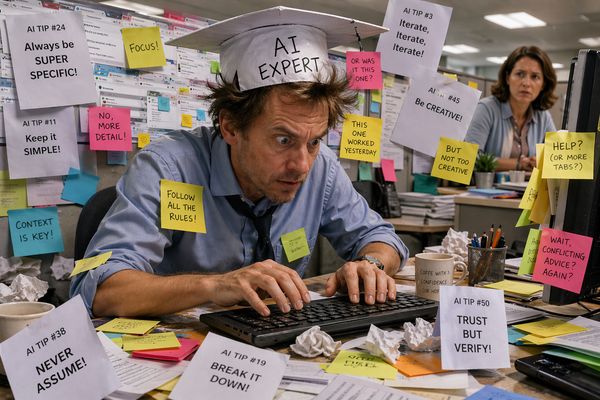
Your team is already learning AI on their own. Some are watching YouTube tutorials at lunch. Others are following Reddit threads, saving TikToks, and piecing together workflows from free courses that may or may not reflect how AI works in a business setting. It feels like momentum, but it might be costing you more than you realize.
Free content has made AI feel accessible, and in some ways, it’s done exactly that. But accessibility isn't the same as accuracy, and exposure isn't the same as skill. When your team learns AI through whatever they can find online, they're not building a foundation. They're building a patchwork, and that patchwork is going to show up in your operations, your client work, and your results.
The problem is that free content, by its nature, is unvetted, inconsistent, and almost never designed with your business context in mind. A 12-minute video on prompting ChatGPT teaches someone how to get a response. It doesn't teach them how to think about AI strategically, protect sensitive data, or apply AI in ways that move your specific goals forward.
Small business owners and marketers are especially exposed here. You don't have the luxury of a dedicated AI team reviewing every output or a legal department flagging compliance risks. What your people learn, they apply. What they apply becomes your standard. That's why the source of their learning matters as much as the learning itself.
The Free Content Trap
Why Free AI Tutorials Feel Like the Right Move
There's a reason free AI content is everywhere right now. The tools are new, the stakes feel high, and nobody wants to fall behind. When your team members start sending you links to YouTube videos or mention they finished a free ChatGPT course over the weekend, it's easy to see that as a win. They're taking initiative and staying current. What's not to like?
The appeal makes sense on the surface. Free AI content is immediate, low-commitment, and abundant. A quick search turns up hundreds of tutorials, prompt guides, and "AI for business" breakdowns, all available without a credit card or a calendar invite. For a small business owner juggling a dozen other priorities, that kind of accessibility can feel like a gift.
But here's what that content is built for: views, clicks, shares. The creators behind most free AI tutorials are optimizing for an audience, not for your business outcomes. They're teaching the most broadly appealing version of AI skills, stripped of the context, structure, and professional application that make those skills useful at work.
That's the trap. It's not that the content is malicious. Most of it is well-intentioned. It's that "broadly useful for anyone" and "specifically useful for your team" are two very different things, and free content rarely bridges that distance.
The Illusion of Progress
What makes this particularly tricky for small businesses is that free learning looks like progress. Your team members finish a tutorial and feel more confident. They start using AI tools more often. Output picks up, at least initially. It's easy to mistake activity for proficiency.
The AI SkillsBuilder® Essentials course was built specifically to address this. It exists because the difference between someone who watched 10 hours of free AI content and someone who completed structured, business-focused AI training is significant, and that difference shows up in real work.
The course gives your team the foundational skills that free content consistently skips. How to:
Construct prompts with purpose
Evaluate AI outputs critically
Apply generative AI in ways that are practical, safe, and repeatable inside a business environment
Free content can spark interest. It can introduce vocabulary. What it can't do is build the kind of reliable, transferable AI proficiency your businessneeds. The longer your team relies on it as their primary source of AI education, the wider the distance grows between what they think they know and what they can deliver.
That distance has consequences, and they don't stay invisible forever.
What Your Team Picks Up
The Skills Problem Free Content Creates Without Anyone Noticing
Ask someone on your team what they learned from a free AI course, and they'll probably give you a confident answer. They learned how to write better prompts. They learned about different AI tools and some tricks for speeding up their work. It sounds solid. The problem is that what they learned and what they can reliably do are often two completely different things.
Free AI content teaches people how to get outputs. It rarely teaches them how to evaluate those outputs, question them, or know when the AI is confidently wrong. That's a critical distinction in a business setting. An employee who trusts every AI-generated result without scrutiny is a liability dressed up as an asset.
Most tutorials show you what a tool can do under ideal conditions, with clean prompts, cooperative results, and no messy real-world variables. Your team walks away thinking they understand the tool. Then they apply it to actual client work, data, and business problems, and the cracks start to show.
Confidence Without Competence Is a Real Problem
There's a psychological dimension here that's easy to overlook. Research on skill acquisition consistently shows that people who learn just enough to feel competent often overestimate their ability more than people who know nothing at all. In AI, that plays out in ways that can quietly damage your business.
An employee who watched three YouTube videos on AI-generated content might start producing blog posts, social media copy, or customer communications without understanding how to fact-check outputs, how to preserve your brand voice, or how to avoid the kind of generic, detectable AI writing that turns customers off. They're not cutting corners intentionally. They just don't know what they don't know.
The AI SkillsBuilder® Essentials course was designed with this exact problem in mind. It doesn't just show learners what AI can do. It teaches them how to think alongside AI tools, recognize weak outputs, and apply structured prompting techniques that produce consistent, usable results in a business context. That kind of critical fluency comes from intentional, sequenced instruction built around real professional application.
The Consistency Problem Nobody Talks About
There's another layer to this that small businesses feel acutely: when every team member is learning AI from different sources, you end up with wildly inconsistent practices across your organization. Everyone is using AI differently, and no one knows it. Nobody has a shared vocabulary, standard, or understanding of what good AI use looks like inside your specific business.
That inconsistency affects your ability to build repeatable processes, train new hires, and scale anything that relies on AI-assisted work. You can't systematize what isn't standardized, and free content, by design, never standardizes anything. Every tutorial has its own approach, terminology, and opinion about what matters most. Your team absorbs all of it, filters none of it, and applies it inconsistently across everything they touch.
Structured training fixes this at the root. When your team learns from the same curriculum, with the same frameworks and the same applied context, they come out speaking the same language. That shared foundation is what makes AI a genuine business tool instead of a collection of individual experiments running in parallel.
The Real Cost to Your Business
What Bad AI Habits Do to Your Productivity, Data, and Reputation
Bad AI habits accumulate quietly, buried inside deliverables that look fine on the surface, inside processes that seem to be working until they aren't, inside client relationships that erode slowly before anyone connects the cause to the output. By the time the damage is visible, it's already been compounding for months.
Productivity is usually the first place it shows up. When employees don't have a structured understanding of how to use AI effectively, they spend enormous amounts of time prompting, re-prompting, editing, and second-guessing outputs that should have been usable in the first draft. The tool that was supposed to save them two hours a day ends up costing them one.
The employees who learned prompting from a handful of YouTube videos are working harder than they should be, producing inconsistent results, and often not realizing there's a better way. They don't know what they're missing because free content never showed them the full picture.
Your Data Is More Exposed Than You Think
Here's where the stakes get serious. Most free AI content doesn't spend much time on data privacy, and the little it does cover tends to be surface-level at best. Your team members are using AI tools every day, and without proper training, many of them are inputting sensitive information into platforms without understanding where that data goes, how it's stored, or whether it's being used to train future models.
Client data, internal financials, proprietary processes, and competitive strategies can all find their way into AI prompts when employees haven't been taught to think carefully about what they share. A single well-intentioned but poorly considered prompt can create a compliance problem, a client trust issue, or a competitive vulnerability that takes years to fully address.
The AI SkillsBuilder Essentials course treats data privacy as a core competency, not an afterthought. Students learn how to work productively with AI tools while maintaining the kind of information hygiene that protects your business and the people who trust you with their data. Free tutorials rarely get around to covering that with any real depth.
Reputation Damage Moves Fast
The output quality problem hits small businesses harder than larger ones. When a big company publishes AI-generated content that misses the mark, it gets lost in the volume. A small business doesn't have that buffer. Clients notice. Prospects notice. The writing sounds off, the facts are slightly wrong, and the brand voice feels hollow. None of it is catastrophic on its own, but the cumulative effect on how your business is perceived can be significant.
Customers today are more attuned to AI-generated content than most business owners realize. They can feel when something was produced without care, and they associate that feeling with your brand. An employee who learned content creation from free AI tutorials, without a structured understanding of how to edit, evaluate, and humanize outputs, is quietly shaping how your market sees you.
Structured AI training teaches your team how to use AI well, how to maintain quality control, and how to produce work that reflects the actual standards of your business. Free content teaches people to produce faster. Real training teaches them to produce better, and for a small business, better is what builds the kind of reputation that compounds over time.
What Structured AI Training Looks Like
How Real Skill-Building Differs from YouTube Rabbit Holes
Structured AI training starts with something free content lacks: a clear, intentional sequence. Instead of jumping between whatever topics get the most clicks, a well-designed curriculum builds on itself. Foundational concepts come first. Applied skills follow. By the time a learner reaches the more advanced material, they have the context to use it, not just recognize it.
That sequencing matters more than most people realize. AI fluency is a way of thinking, and that kind of thinking develops through layered instruction, not random exposure. A person who completes a structured course comes out with a mental framework they can apply to new tools, platforms, and use cases as AI continues to evolve. Someone who pieced their knowledge together from free content has a collection of tactics with no connective tissue holding them together.
For small businesses, the practical difference shows up fast. Structured training produces employees who can assess a task, determine whether AI is the right tool for it, construct a prompt that gets a usable result, and evaluate that result with enough critical judgment to know when it needs work. Free content produces employees who can open ChatGPT and type something in. Both feel like AI skills. Only one of them functions as one inside a real business environment.
Built for Business, Not for Views
One of the most important distinctions between structured training and free content is the context in which skills are taught. Free tutorials are built for the broadest possible audience. Business-focused training is built for the specific realities of professional work, which means it covers things that general AI content consistently skips.
Privacy and data handling get real attention. Prompt construction is taught as a discipline, not a party trick. Output evaluation is treated as a skill in its own right, not an afterthought. Learners come away understanding not just how to use AI tools, but how to use them responsibly and repeatedly in a way that produces reliable results across different tasks and contexts.
The AI SkillsBuilder Essentials course was built with exactly that focus. It's designed for people who need to apply AI skills in a real work environment, not people who want to experiment with AI for personal curiosity. The curriculum covers practical prompting frameworks, responsible AI use, output quality assessment, and applied exercises that translate directly to the kind of work your team is already doing. Learners don't finish the course with a vague sense of AI awareness. They finish with skills they can use the next morning.
The Difference Between Knowing and Doing
Free content creates a lot of AI awareness. Structured training creates AI capability, and for a business, capability is the only thing that counts.
Awareness means your team has heard of prompt engineering, knows ChatGPT can write emails, and has watched enough tutorials to feel comfortable opening an AI tool. Capability means they know how to get consistent, high-quality outputs, apply AI across multiple business functions, and adapt their approach when a tool doesn't behave the way they expect.
Investing in structured AI training also sends a signal to your team that matters more than most owners account for. When you provide real training, with real curriculum and real credentials, you're telling your people that AI proficiency is a professional standard in your organization, not a personal hobby. That shifts how seriously they take it, how consistently they apply it, and how much they invest in continuing to develop those skills over time.
Free content will always be there for exploration and curiosity. For building a team that uses AI with skill, consistency, and confidence, it was never going to be enough.
Stop Leaving Your Team's AI Education to the Internet
Free content isn't going away, and neither is the temptation to treat it as a training strategy. It's fast, it's cheap, and it creates just enough visible activity to feel like progress. But a team full of people who learned AI from whatever they could find online is a collection of unverified habits, inconsistent practices, and unchecked risks operating inside your business every day.
The good news is that fixing it doesn't require a massive overhaul, it simply requires a decision: to give your team a real foundation instead of leaving them to build one themselves from whatever the algorithm serves up next.
The AI SkillsBuilder Essentials course is where that foundation starts. It's structured, practical, and built specifically for the kind of work your team is already doing. Learners come away with prompting frameworks they can apply immediately, a clear understanding of how to use AI responsibly, and the critical judgment to know when an output is ready and when it needs work.
Give your team the training that prepares them. Register now for AI SkillsBuilder Essentials.