

The strategic approach that's letting executives enhance operations without hiring consultants or building massive tech teams
You're running three meetings back to back when someone forwards another article about AI changing their industry. You skim it between calls. It sounds important. It probably is important. But you've got a quarterly review in two hours, a hiring decision that can't wait, and a client situation that needs your attention right now.
So the article gets saved to that folder of things you'll read when you have time. Except you never have time.
Meanwhile, your competitor just announced something. A faster turnaround. A new capability. Something that makes you wonder if they've figured out what you haven't. Your team keeps asking about AI tools. Your board mentions it in passing, casual but pointed. Everyone assumes you have a plan.
You don't have a plan. You have a list of things that might be plans if you could ever find eight uninterrupted hours to think through what AI means for your business.
The pressure builds in strange ways. A younger hire mentions a tool they used at their last company. A potential client asks what AI capabilities you offer. Your CFO wants to know if you're budgeting for this. Each question feels like proof you're behind, and each day that passes without answers makes the gap wider.
You need something that works with how you operate. Not a six month discovery process, a complete restructuring, a new department, or a seven figure investment. You need a way to implement AI that fits into the margins of an already full schedule and produces results fast enough to matter.
When You Know You're Falling Behind But Can't Stop Moving
The first sign isn't dramatic. It's a small moment in a regular meeting when someone mentions a competitor's turnaround time and you realize theirs is half of yours now. Six months ago, you were even. Now they're faster and you can't figure out how.
You start noticing these moments everywhere. A prospect chooses another vendor and mentions capabilities you don't offer. A team member asks if they can use ChatGPT for customer research and you're not sure what to tell them. Your marketing director wants to know the AI strategy so they can communicate it to clients. You've been working on that for three months.
The board meeting gets awkward when someone asks about AI integration. You give an answer that sounds strategic but feels hollow. Nobody challenges you directly, but the silence after you speak says enough.
Your inbox fills with pitches from AI consultants. Their proposals start at $50,000 for a discovery phase. They want twelve weeks just to tell you what you should do. By the time they finish analyzing, your competitor will have lapped you again.
The really frustrating part is that you know your business better than any consultant ever will:
Where the bottlenecks are
Which processes waste time and which decisions require judgment you can't automate
Where AI could help if you just knew how to apply it
But that knowledge sits useless because you don't have the framework to turn understanding into action.
Your team wants direction. Some are already using AI in ways you don't know about because there's no clear guidance. Others are waiting for permission that never comes because you're still trying to figure out what the right answer is. Budget season makes it worse. Finance wants to know what you're spending on AI initiatives that you don't have yet. You have experiments, ideas, and a growing sense that you're making this harder than it needs to be.
You recognize the pattern because you've seen it before in other transitions. The leaders who moved fast gained advantages that were hard to overcome. The ones who waited lost ground they never recovered. You know which side of this you want to be on. You just need a way to get there that doesn't require you to stop running your business.
The Implementation Trap That Keeps Leaders Stuck
Most business leaders approach AI the way they'd approach any major initiative. They want to understand it fully before committing, reading articles, attending webinars, and talking to vendors. They wait until they feel confident enough to make the right decisions.
This approach works for most business problems. It fails completely with AI.
That’s because there’s too much information pointing in too many directions. One expert says focus on automation. Another says it's about augmentation. A third insists you need a data strategy first. They're all right and none of them tell you what to do tomorrow.
So you try delegating. You tell your IT director to explore options, or you ask your operations manager to identify use cases. They come back with ideas that sound reasonable but don't connect to your actual business priorities. The proposals either aim too small, automating tasks that don't matter, or too large, requiring investments you can't justify.
The consultant route looks appealing until you see what it involves. Discovery phases that take months. Stakeholder interviews that pull your team away from real work. Frameworks and methodologies that feel more like academic exercises than business tools. By the time they deliver recommendations, the market has shifted and their insights feel dated.
Some leaders try the opposite approach. They pick a tool and tell everyone to start using it. No strategy, no structure, just action. This creates chaos in a different way. People use AI inconsistently. Results vary wildly. Nobody knows what works because there's no framework for measuring success. Six months in, you've spent money and time with nothing to show for it except frustrated employees and skeptical executives.
The real trap is assuming you need to become an AI expert before you can implement AI solutions. You don't need to understand transformer architectures or training datasets. You need to know how to identify where AI applies to your business and how to implement it in ways your team can repeat. That's a completely different kind of knowledge, and it doesn't take months to acquire.
What keeps leaders stuck isn't the technology. It's the lack of a practical framework that connects business problems to AI solutions without requiring you to rebuild your entire operation or hire a team of specialists you don't need.
The AI Strategy Canvas®
The real shift happens when you stop thinking about AI as a technology problem and start treating it as a strategy problem. Strategy problems are complex, but they become manageable when you break them down the right way.
The AI Strategy Canvas is a single-page tool that maps out everything you need to implement AI successfully. It's divided into sections that force you to think through the essential elements before you start building anything.
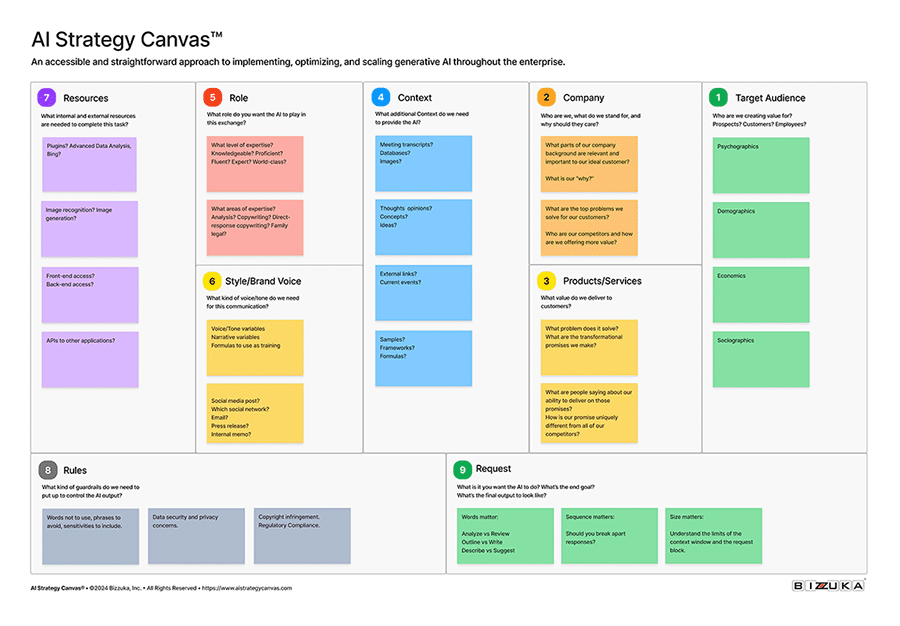
Target Audience defines exactly who you're serving with your AI applications. Different audiences need different approaches, and this section makes you choose instead of trying to serve everyone poorly.
Company comes next. Here you articulate your organization's relevant information, your capabilities, and what makes your business unique. This grounds every AI decision in reality instead of generic best practices that don't fit your actual operation.
Products and Services defines what you offer and how AI might enhance it. This section prevents the common mistake of implementing AI for its own sake instead of connecting it to what you deliver to customers.
Context is where you define the situation, the background information, and any constraints that matter. Not vague statements about wanting to be innovative, but specific details about your business environment that will shape how AI gets applied.
Role identifies who you want the AI to be while writing.
Style/Brand Voice addresses how you want AI to communicate on behalf of your business. Voice matters. Brand matters. This section ensures AI-generated content sounds like your company, not a generic algorithm.
Resources captures what you have available. Budget, yes, but also data, technical capabilities, and any relevant documents. This is where fantasy meets reality and you figure out what's possible with what you have right now.
Rules establishes the boundaries and guidelines for AI implementation. What the AI should never do, what standards it must maintain, what constraints it must respect. This prevents costly mistakes and keeps AI aligned with your business policies.
Request specifies what you're asking the AI to do. This turns vague ideas into concrete instructions that the AI can execute.
The canvas removes ambiguity. Scalable prompts remove inconsistency. Together, they turn AI implementation from a months-long discovery process into a structured approach that produces results in weeks.
The best part is that you don't need to become a technical expert in order to use it. You don't need months of discovery or teams of specialists. Just a structured approach that connects your business problems to AI solutions and gives your team the tools to execute without constant oversight.
That's exactly what the AI Mastery for Business Leaders course delivers. 3-6 weeks that fit into the margins of a full calendar. No unnecessary stuff about AI history or theory you'll never use. Just practical frameworks starting with the AI Strategy Canvas and scalable prompts that your team can implement immediately.
The course moves at the speed business operates. Enroll now and start building the advantage your competitors are already enjoying.