
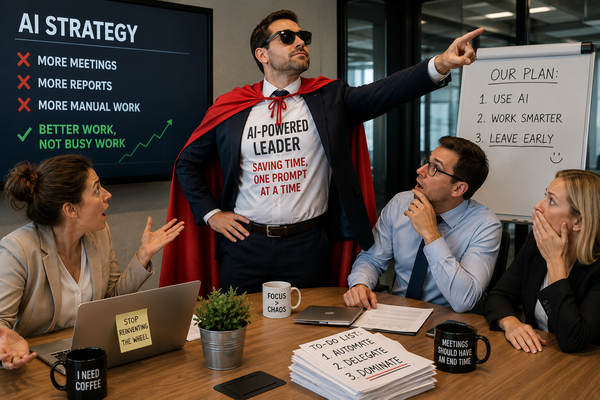
An AI-first company culture is an operating environment where leaders and employees use AI as a routine part of how they plan, communicate, and solve problems, not as a special initiative that runs parallel to real work. For CEOs, COOs, and the operational leaders accountable for AI adoption, building this kind of culture means addressing two problems at once: the organization's people don't have a shared foundation for using AI, and leadership doesn't have a clear structure for making AI adoption stick. The four moves that consistently produce results are changing leadership behavior first, building organization-wide AI literacy, integrating AI into daily workflows, and creating visible accountability for progress.
Research from Harvard Business Review found that while executives remain highly optimistic about AI investment, middle managers report far lower confidence in adoption, readiness, and measurable return. That disconnect is widening inside most organizations, and it's more expensive than it looks.
Culture is what determines whether AI compounds into a real advantage or becomes another abandoned initiative.
You can purchase the best AI tools available and still fall behind. Employees don't change because software appears. They change when leadership creates clarity, safety, accountability, and momentum around a new way of working. And right now, most organizations are skipping that part.
Executives often underestimate how unsettling this transition feels to the people responsible for executing it. Your employees are asking questions they rarely surface directly:
Am I falling behind?
Will AI replace part of my role?
What happens if I make mistakes using these tools?
Does leadership actually understand how this changes my workload?
Am I expected to figure this out on my own?
Silence around those questions produces resistance. Resistance slows adoption. Slow adoption produces frustration at the executive level. Leadership concludes that employees won't adapt; employees conclude that leadership is disconnected from what's actually happening. That cycle is hard to break once it's running.
The organizations making real progress in AI are approaching this differently. They treat AI as a cultural change first and a technology initiative second. They train leaders before demanding results from teams. They give managers room to experiment rather than forcing immediate perfection. They measure readiness, confidence, and workflow adoption alongside productivity metrics.
Most importantly, they build environments where employees feel included in the transition rather than threatened by it.
Companies that build AI-fluent cultures now will move faster, hire better, and retain stronger people over the next five years. The window to do this proactively is still open, but it is narrowing.
Why Most AI Initiatives Fail Before They Ever Scale
What causes AI adoption to stall inside most organizations?
Most AI initiatives don't collapse visibly. They fade.
The company announces a new AI direction, leadership sets ambitious goals, teams attend workshops, employees test tools, and productivity spikes briefly in one or two departments.
Then momentum disappears.
Six months later, executives are frustrated because behavior hasn't changed. Managers are exhausted from carrying another operational burden. Employees have quietly returned to old habits.
The technology didn't fail. The conditions for adoption were never built.
Many organizations still approach AI as if it were a standard software rollout: purchase licenses, schedule training, expect adoption, move on. But AI changes how people work far more fundamentally than traditional software. It affects communication, decision-making, creativity, management structures, and how people relate to their own roles. People aren't simply learning a new platform; they're adapting to a different relationship with work itself.
That creates emotional friction most leaders underestimate.
Why do executives and managers experience AI adoption so differently?
HBR's research revealed a sharp divide between executives and middle managers on AI readiness and perceived return. Nearly half of executives reported strong positive results from AI investment. Far fewer middle managers agreed.
The reason isn't disagreement. They're living completely different experiences.
Senior leaders use AI for strategic drafting, summarization, and high-level analysis. The tools often feel immediately impressive. Middle managers inherit the operational weight: integrating AI into existing workflows, calming employee concerns, solving process confusion, monitoring quality, and maintaining productivity while learning unfamiliar systems under pressure. Executives see possibility, managers feel friction; both are right. The problem comes when leadership assumes everyone shares the same level of confidence.
Employees notice this quickly. Leadership says AI will create efficiency, yet workloads increase during rollout. Executives encourage experimentation, but employees worry about making visible mistakes. HR promotes innovation while employees quietly wonder whether their role is being automated out from under them.
When uncertainty grows, people protect themselves. Some avoid AI entirely. Others start using personal ChatGPT accounts or other unsanctioned tools (a behavior often called shadow AI) without governance, oversight, or security considerations. More than 80% of workers already use unapproved AI tools on the job, and 75% of those employees have shared potentially sensitive company data with those tools. When a CISO surfaces that reality, the conversation changes fast.
The result is fragmentation. One department builds real capability. Another resists. Policies stay unclear, expectations become inconsistent, and trust erodes.
At that point, many executives conclude their workforce is resistant to change. Usually, what's actually happened is that the workforce responded to unclear leadership.
Successful AI adoption requires leaders to reduce confusion at every layer of the organization. Employees need to understand why AI matters, how it affects their specific role, what success looks like, where experimentation is encouraged, which guardrails exist, and how leadership plans to support them through the transition. Without that clarity, AI becomes another corporate initiative people endure rather than embrace.
The Framework for Building an AI-First Culture
How do you turn AI from a scattered initiative into an operating standard?
Most companies are still treating AI like a project. Projects have timelines, budgets, and end dates. What you're actually building is a set of habits and standards that shape how people work every day.
That's a different challenge entirely. It requires leadership to build conditions that reward curiosity, reduce fear, and create clear expectations around experimentation and growth.
Why does leadership behavior determine whether AI adoption succeeds or fails?
Employees pay close attention to what leaders actually do, not what they say in all-hands meetings.
If executives talk about AI but never use it where people can see it, teams take note. If leadership pushes adoption while resisting workflow changes themselves, employees hesitate. If managers receive pressure without support, frustration spreads.
Behavior shapes culture more reliably than policy does. Leaders need visible AI habits. That means using AI during strategic planning, sharing examples of what they've tried and what worked, talking openly about what didn't, encouraging responsible experimentation across departments, and creating enough psychological safety that early mistakes aren't career events.
Employees don't expect leaders to have all the answers. They respond when leaders are honest that they're learning too.
This matters because fear fills the silence. Many of your employees already suspect AI will reshape their role. Some quietly worry they won't adapt fast enough to stay relevant. You can't eliminate that uncertainty entirely, but you can make people feel less isolated by it. The organizations with the strongest AI progress create environments where employees feel part of the transition, not on the wrong side of it.
What does organization-wide AI literacy actually look like?
Most companies invest in training a handful of AI specialists while leaving the broader workforce to figure it out on their own. That creates dependency rather than distributed capability.
Organization-wide literacy means your employees understand what AI can realistically do, where it creates risk, how to evaluate outputs critically, which workflows benefit most, and how to use AI responsibly inside your specific environment.
Without that foundation, adoption becomes uneven. One department moves quickly. Another freezes. Managers invent inconsistent rules. Employees build private workarounds that leadership never sees.
The result is confusion that looks like innovation from a distance.
According to Deloitte's CTO, companies are spending 93% of their AI budgets on technology and only 7% on the people expected to use it. That ratio explains why tools get purchased and nothing changes operationally. Formally trained employees are 2.7 times more proficient than self-taught peers, and that proficiency difference doesn't close by giving people access to more software.
The most effective organizations build AI learning into the normal flow of work: weekly experimentation sessions, role-specific use cases, shared prompt libraries, documented workflows, peer-led learning groups, and clear governance standards. Small wins build confidence, and confident employees change their habits.
How do you integrate AI into daily workflows without burning out your team?
Many organizations accidentally isolate AI from actual work.
Employees attend training sessions, then return to the same routines they used the day before. Nothing changes operationally, and AI becomes optional rather than integral.
Leaders need to identify where AI naturally reduces friction inside existing workflows. When employees experience visible time savings on work they were already doing, adoption accelerates on its own. According to an Express Employment Professionals-Harris Poll, 72% of U.S. companies use AI while 55% lack the training to deploy it effectively. The tool isn't the issue. The missing connection between the tool and the person using it is.
One common mistake at this stage is pushing for maximum efficiency too quickly. Employees still need time to develop judgment around prompting, editing, output verification, and integration. AI output isn't perfect. Teams that don't have room to learn and refine tend to either abandon the tools or produce work that requires more cleanup than it saves.
The better approach is steady operational integration. Make AI practical first, then scale.
How do you create accountability for AI adoption without micromanaging?
Culture changes when behavior becomes measurable and visible.
Without accountability, AI adoption stays as scattered experimentation with no lasting direction.
Strong organizations track AI adoption across departments, workflow improvements, employee confidence levels, time savings, and responsible AI usage. They don't do this to penalize people who are slower to adopt. They do it because measurement creates visibility, and visibility creates momentum.
They also recognize progress publicly. Employees who identify useful workflows get acknowledged. Managers helping their teams adapt get support. Departments generating measurable improvements share their process with the rest of the company.
DataCamp's 2026 State of Data and AI Literacy Report found that 82% of enterprise leaders say they provide AI training, yet 59% still report a significant AI skills shortfall. The reason, consistently, is that training was delivered into an organization with no governance structure, no internal ownership, and no accountability mechanism to turn individual learning into shared capability. When those structures are in place, the training works.
Momentum spreads when people can see progress becoming normal. Employees stop asking whether AI matters and start asking how much further they can take it. That's the shift from running an AI initiative to operating like a company where AI is just how work gets done.
What Separates Organizations That Make AI Work From Those That Keep Struggling
If you're the COO, CEO, or operational leader accountable for AI adoption at your organization, the situation probably looks familiar: your people are already using AI in ways you can't fully see, you've got a board or executive team expecting a progress update, and every vendor you talk to is selling either tools or training. Neither one, on its own, produces the organizational capability you're actually accountable for.
The organizations that get this right don't start with tools. They don't start with training. They start with structure: governance that tells employees what they can and can't do with AI, a cross-functional team that owns AI oversight and accountability, and role-specific workflows that make AI practical before anyone asks employees to scale.
That's exactly the approach behind the AI Mastery for Business Leaders program, built specifically for executives, managers, and operational leaders who need to move from scattered AI experimentation to measurable organizational progress. The program covers how to build the governance infrastructure, create the internal ownership structure, and develop the practical AI habits that stick across an organization of real complexity.
The distance between AI-ready organizations and those still figuring it out is widening every quarter. The companies that started building this foundation 12 months ago are now compounding on it. The ones that wait for conditions to be perfect are watching that distance grow.
Stop running AI as an initiative. The AI Mastery for Business Leaders program builds the conditions for it to actually work. Enroll now.
Built for the leader who got the mandate. Designed for organizations with 50 to 5,000 employees navigating real operational complexity, not theory.