HR and people operations professionals are being systematically skipped in corporate AI training budgets, and the cost shows up in every department they support. This happens because AI training programs are built around functions that are easy to measure: sales pipelines, engineering output, and operations efficiency. HR work is harder to quantify, so the investment rarely arrives. The result is a people operations team running 2026 workloads on 2022 tools, spending hours every week on tasks that well-built AI workflows could handle in minutes. AI SkillsBuilder® Essentials is a self-paced AI training program built for HR and people operations professionals who need practical, applicable skills without a technical background. The curriculum maps to real HR tasks: drafting communications, summarizing exit data, building onboarding templates, answering recurring policy questions. Proficiency comes from applying the skills to work you're already doing, not from studying abstract scenarios that have nothing to do with your job.
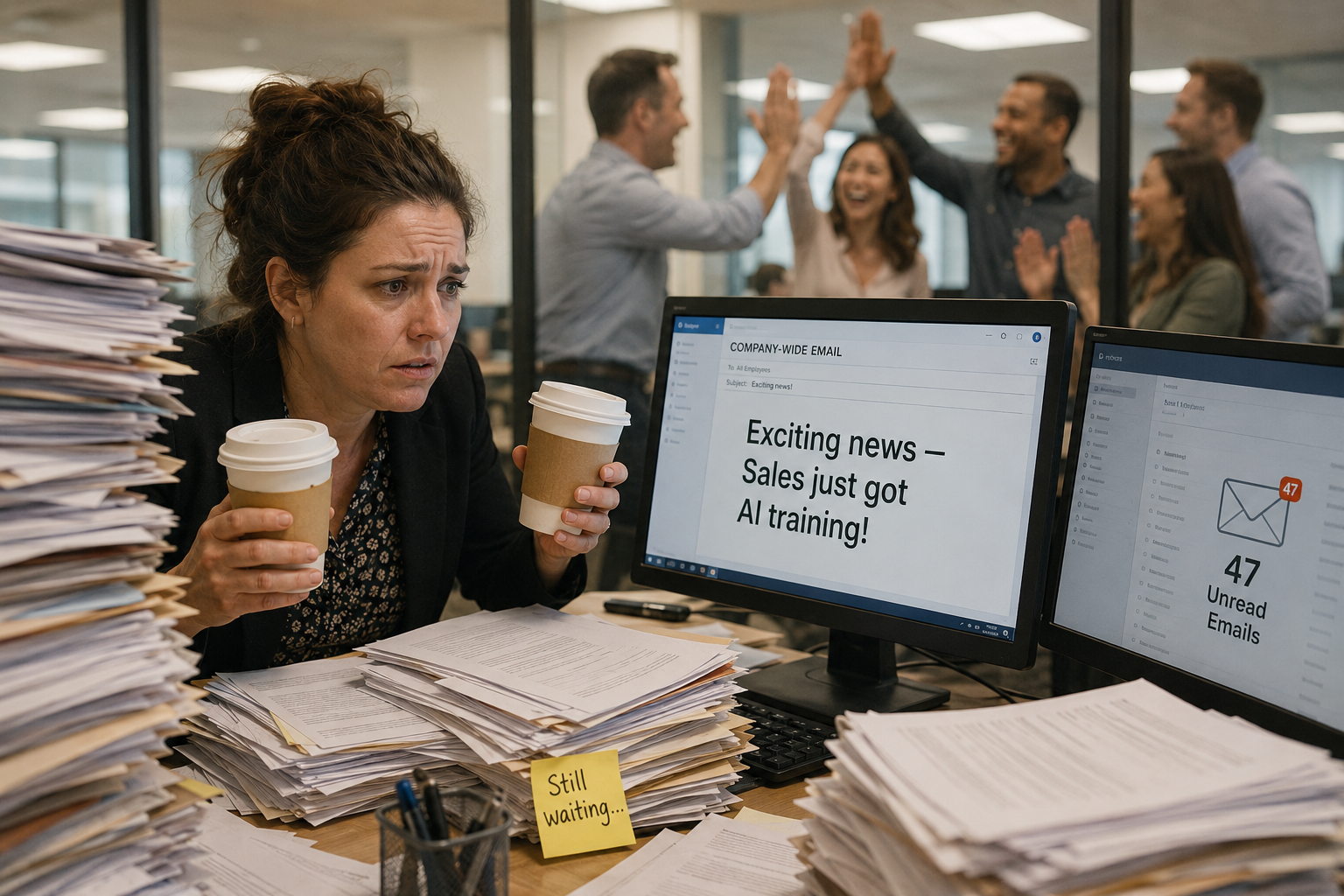
You know something's off. The job requisitions are stacking up and the onboarding checklists are still being filled out by hand. Your inbox has 47 unread messages from managers who all want the same answer to the same policy question. And somewhere in the back of your mind, there's a voice that keeps saying: there has to be a better way to do this.
The problem is that every conversation about AI at your company seems to happen in a room you weren't invited to. Executives are fired up about it, IT is building with it, and sales got a three-day workshop. But HR is sitting with the same spreadsheets it had in 2022, being told to "stay tuned."
That's a much bigger problem than you may realize. HR teams are responsible for the one asset every company claims is its most important: people. And yet when it comes to equipping the people who manage those people with modern tools, the investment rarely shows up where it's needed most.
Why is HR administrative workload still this heavy in 2026?
There's a version of your day that never makes it into the job description. It starts before your first meeting and ends long after the last one. Policy questions pile up from managers who could have looked it up but didn't. Offer letters need three rounds of edits because the template hasn't been updated since the last reorg. Exit interview notes sit in a folder nobody reads, benefits enrollment emails go out manually every open season, and performance review reminders get copy-pasted into Outlook like it's 2011.
None of this is strategic work. All of it lands on your plate anyway.
People operations teams carry a disproportionate amount of invisible administrative weight. McKinsey research found that managers spend less than 28% of their time on actual people leadership and talent work, with the rest absorbed by administrative responsibilities that haven't been redesigned in years. That's a structural problem, and it's costing your organization more than most executives realize.
Here's what makes it worse: repetitive tasks wear people down differently than complex ones do. Answering the same FMLA question for the fourteenth time this quarter doesn't require deep expertise. Patience, a good memory, and time you don't have are all it takes. Manually tracking onboarding progress across a dozen new hires, formatting job descriptions to match a style guide, pulling together turnover data for a leadership report that could have been generated in minutes with the right tools: all of it is yours.
Your team is struggling because it's under-equipped.
AI tools exist right now that could absorb a significant portion of this load. Drafting routine communications, summarizing meeting notes, answering policy questions through a trained internal assistant, generating first drafts of job postings, building onboarding checklists customized by role. None of these are futuristic capabilities. HR teams at organizations that have invested in building AI skills are already using them today.
What separates those teams from yours is that someone at those companies made a decision to train the people doing the work, rather than assuming the tools would teach themselves.
The administrative weight your team carries right now isn't permanent. Waiting for it to lift on its own, though, is a bet that hasn't paid off yet.
Why do AI training budgets consistently skip HR teams?
Ask most HR leaders whether their organization is investing in AI, and the answer is yes. Ask whether that investment includes their own team, and the answer gets complicated.
There's a pattern playing out inside companies right now that's worth naming directly. When AI training budgets get allocated, the money flows toward the functions that are easiest to measure. Sales gets trained because pipeline numbers are visible. Operations gets trained because efficiency gains show up in reports. Engineering gets trained because output is quantifiable. HR watches from the sideline, told to wait for the next cycle, assured that something is coming.
Something rarely comes.
Part of this is a perception problem. People operations work is seen as relational, intuitive, and human. The assumption, often unstated, is that AI belongs in technical functions and HR belongs in the business of people. Never mind that HR professionals spend enormous portions of their day on tasks a well-prompted AI model could handle in seconds. The bias runs deep, and it's costing organizations real productivity.
The Wharton Human-AI Research and GBK Collective's 2025 Enterprise AI Adoption Study found that while 82% of enterprise leaders now use generative AI weekly, adoption inside HR functions has lagged behind sales, marketing, and operations by a significant margin. Meanwhile, 43% of those same leaders warn that employees risk falling behind as AI tools develop. Those two facts sitting next to each other should be alarming to anyone running a people function.
There's a second reason HR gets skipped, and it's more uncomfortable than the first. When companies do roll out AI training, the curriculum is almost never built for the problems HR actually faces. Generic AI literacy programs teach employees how to write prompts for content creation or data analysis. Useful skills, but not the ones an HR business partner needs when she's trying to build a repeatable onboarding experience, restructure a recruiting workflow, or draft a sensitive employee communication without spending 45 minutes staring at a blank screen.
Training that doesn't speak to the actual work doesn't stick. HR professionals sit through a two-hour workshop, learn how to ask ChatGPT to summarize a document, and go back to their desks with nothing that changes what tomorrow looks like. The training checked a box, but the workload didn't move.
There's a third factor underneath all of this: the pace at which HR teams are being asked to operate has accelerated faster than their tools have. Recruiting volume, compliance complexity, and employee relations demands are all up. Managers need more from their HR partners, not less. And the people absorbing that pressure are running on tools and workflows designed for a slower, simpler environment.
Most HR professionals aren’t resistant to AI. They’re curious about it, even excited. What they're missing is training built around the real tasks that fill their days and designed to produce skills they can use before they leave the room.
That training exists. Using it well requires knowing what to look for.
How do you build AI proficiency in an HR team without disrupting daily operations?
Most AI training programs start in the wrong place. They open with a capabilities overview, walk through a list of tools, and send people home with a login and a wish of good luck. Six weeks later, nothing has changed except the line item on the training budget.
Building real AI proficiency inside a people operations team requires a different sequence. Start with the work, not the technology.
Step 1: Map the Tasks That Are Eating Your Team Alive
Before anyone opens a single AI tool, spend 30 minutes with your team listing every task that gets done more than twice a week. Don't filter for complexity. Include the small things, because the small things are usually where the most time goes.
You're looking for three categories:
Purely informational tasks, where someone is retrieving or reformatting something that already exists: policy lookups, job description edits, benefits summaries, compliance reminders.
First-draft tasks, where the human judgment comes in the refinement, not the creation: offer letters, onboarding emails, interview question sets, performance improvement plan templates.
Synthesis tasks, where someone is pulling from multiple sources to produce a single output: turnover reports, headcount summaries, workforce planning decks.
Every task in those three categories is AI-ready right now. Write them down.
Step 2: Sequence Learning Around Real Work, Not Hypotheticals
The fastest way to kill adoption is to train people on scenarios that have nothing to do with their actual job. When an HR coordinator sits through a module about AI in supply chain management, she doesn't come away inspired. She comes away certain this isn't for her.
Effective AI training for HR teams maps each skill directly to a task your team already does. Learning to write effective prompts? Practice it on a real job posting that needs to go out next week. Learning to use AI for document summarization? Pull an actual exit interview transcript and summarize it. Learning to build templated responses? Use the policy question your inbox receives every single Monday.
This is the principle behind skills-based AI training, and it's what separates programs that produce lasting behavior change from ones that produce completion certificates. The Wharton and GBK Collective research found that the most-used AI capabilities inside enterprises are also the highest-rated for performance, specifically document summarization, data analysis, and document editing. Those three capabilities alone cover a substantial portion of what HR professionals do every day.
Step 3: Start With One Workflow, Not the Whole Department
There's a version of AI adoption that tries to change everything at once. New tools, new processes, new expectations, all landing on a team that's already running at capacity. That version almost always fails, not because the technology doesn't work, but because the people running it didn't have enough bandwidth to absorb the change while keeping everything else moving.
Pick one workflow. Make it one your team finds genuinely painful. Onboarding document preparation is a strong starting point for most HR teams. Interview scheduling communications work well too. Whatever you choose, the goal is to run that single workflow through an AI-assisted process for 30 days before touching anything else.
Document what changes. Track the time difference. When your team feels the relief of 30 minutes returned to their week, the skepticism about AI becomes something they disproved with their own hands.
Step 4: Choose Training Built for People Who Aren't Engineers
This is where most organizations make a mistake that's easy to avoid. They purchase enterprise-wide AI licenses or generic digital literacy programs, then wonder why HR isn't using them.
AI training designed for business professionals, specifically for people in operational and people-facing roles, is structured differently than training designed for technical teams. It assumes no coding background. It teaches prompting as a communication skill, not a technical one. It grounds every lesson in business scenarios a non-engineer would recognize.
Look for:
Programs that include HR-relevant use cases in the curriculum, not just sales or marketing examples
Self-paced formats that let team members learn during the natural lulls in a people operations calendar, not during the open enrollment crunch or the Q4 performance review cycle
Training that produces a credential, because credentials matter inside organizations when HR teams need to demonstrate the return on their own development investment
Step 5: Protect the Time or the Training Won't Happen
This is the step most plans skip, and it's the one that determines whether the others succeed.
McKinsey's research on managers consistently shows that people will not find time for skill-building while they're simultaneously being held accountable for every existing deliverable. The administrative burden doesn't pause because training is scheduled. HR professionals who are expected to complete AI coursework on top of full workloads will deprioritize the coursework every time. Not because they don't care, but because the inbox doesn't care that they're trying to grow.
Building AI skills into an HR team requires explicitly carving out protected learning time, communicating to the rest of the organization that HR team members are in development, not available for non-urgent requests during those windows. It means senior HR leadership treating the training investment with the same seriousness as any other strategic initiative. And it means measuring progress, not just enrollment.
Training that gets scheduled but never protected is just a line on a calendar that never gets honored.
When HR professionals spend less of their day on tasks that don't require their expertise, something real opens up. The conversations that were getting rushed get the attention they deserve. The employee relations issue that would have been handled reactively gets caught earlier because someone had time to notice the pattern. The workforce planning analysis that used to get delegated because nobody had bandwidth gets done by the person who understands the data best.
This is the version of HR leadership that most people operations professionals went into the field to practice. Not the one where Tuesday is mostly formatting and Wednesday is mostly answering emails.
Research from the Wharton Human-AI Research center found that among enterprise leaders who report positive returns from AI, the gains consistently show up in the same places: document summarization, communication drafting, and data analysis. For HR teams, those three capabilities touch nearly every function.
Your HR team isn't behind because they're incapable. The skills shortage isn't a character flaw, and the fact that AI training has largely skipped the function most responsible for your people is a fixable organizational decision, not a permanent condition.
We built AI SkillsBuilder Essentials for this situation specifically. It's a self-paced program for business professionals who need practical, applicable AI skills without a technical background. The curriculum teaches prompting as a communication skill, grounds every lesson in real workplace scenarios, and moves at a pace that fits inside a working week without asking your team to choose between learning and delivering.
HR professionals who complete the program walk away with skills they can use that same day. Register now.