Everyone's calling themselves an AI strategist. Only a few can prove it.
There’s a rising tide of self-declared AI experts; most of them freshly minted after a weekend with ChatGPT and a few YouTube videos.
Scroll LinkedIn. Sit through a webinar. Attend a panel. Suddenly, everyone’s rebranded themselves as an “AI marketing guru.” But when it comes time to build a framework, apply models, or lead a team through implementation, many of them fold. The talk doesn’t match the toolkit.
This is eroding trust.
Clients get confused. Faculty who try to introduce AI into the curriculum face pushback because someone else burned the classroom with bad guidance. Consultants lose deals because their prospect just sat through a cookie-cutter workshop that claimed to cover it all. The noise is drowning out real strategy. And the longer it continues, the harder it becomes to stand out with genuine expertise.
If you’ve done the work, and you’re the one people turn to when AI questions get complicated, it’s time to mark that difference clearly. This is where credentials matter. Not just to add a badge next to your name, but to protect the integrity of your work.
The Illusion of Expertise Is Damaging the AI Space
It’s easy to sound like you understand AI. Use the right terms, copy a few prompts, maybe share a chart. That’s what a lot of people are doing right now. And at first glance, it works. It gets likes. It gets speaking gigs. But behind the curtain, the knowledge is thin, and it’s causing real damage.
Educators are losing credibility with students who know more about ChatGPT than their instructors. Consultants are pitching AI roadmaps they can’t implement. Agencies are promising intelligent automation, but delivering macros and templates dressed up as innovation. It’s hurting the people who were genuinely trying to explore what AI could do for their business.
The trust that should be growing around AI is breaking down instead. And when trust breaks, momentum dies.
Everyone’s excited about AI, but no one wants to feel fooled. Businesses are pulling back. Colleges are second-guessing program investments. Leadership teams are hesitating. They’ve been burned once and they’re not eager to risk it again. If you're in the room offering advice, you need more than enthusiasm. You need evidence that you know what you're doing.
Without it, your voice gets lumped in with the rest. Your ideas don’t land. Your strategies feel too abstract. The opportunity slips because you didn’t mark yourself as different from the noise.
Certification Gives Weight to Your Name in the Room
Envision the moment: a strategy session starts, and people exchange nods and titles. The room is thick with opinions. But when it’s your turn to speak, they stop and listen. You’re not another voice. You’re the one who brought the receipts.
That’s what certification gives you. Not just a paper or bullet point. It’s proof that you’ve moved past theory. You’ve put time into mastering the mechanics, gone through structured learning, applied the frameworks, and seen what works. When others are guessing, you’re guiding.
In the AI space, that separation matters more than ever. The flood of self-proclaimed experts has made it hard for decision-makers to know who to trust. They’re looking for signals. A credential cuts through the clutter and tells the room you’ve done the work.
It also shapes how you show up. You present with more confidence because you’ve tested your ideas under pressure. You lead with clarity because you’ve been trained to solve real-world problems, not just talk about them. And when pushback comes, you’ve got the foundation to support your strategy.
Certification doesn’t make you an instant authority, but it validates the authority you’ve earned. It creates alignment between what you say and what you’ve demonstrated. And in high-stakes spaces where time and trust are currency, that alignment can be the difference between being heard or being ignored.
Your Future Clients, Students, and Employers Are Already Filtering
They may not say it out loud, but they’re already sorting through the noise. When they scan your profile, watch your presentation, or read your proposal, they’re asking how they can trust that you know it.
Right now, the AI space is flooded with talent claims. Every pitch deck has AI baked in. Every resume says “prompt engineer.” Every strategist leads with “innovation.” But most of it falls apart under scrutiny. The people who matter (the ones making decisions about hiring, funding, and collaboration) are watching closely. They’re filtering faster than ever.
If you’re showing up without credentials, you’re already at a disadvantage. It’s not because your ideas aren’t strong. It’s because the room is full of others claiming the same thing. And your audience is tired of guessing who’s real.
For educators, it means course proposals get passed over. For consultants, it means the client picked someone else without asking for a second meeting. For AI marketing leaders, it means your vision never gets buy-in because your team can’t see the track record behind it.
When people are overwhelmed by options, they reach for anything that helps them decide faster. Credentials do that. They signal seriousness, reduce the risk of disappointment, and make it easier for the right opportunities to find you. And harder for you to get filtered out before you’ve even had a chance to speak.
Certification Is How You Lead
Trends pass. Tools change. Platforms rise and fall. But strategy stays. And the ones who lead through every shift aren’t the loudest, they’re the most prepared.
Right now, AI feels urgent. Everyone’s experimenting and watching for the next big shortcut. But the professionals who will matter five years from now are the ones who stopped chasing trends and started building deep, transferable skill sets. They’re not focused on what’s flashy. They’re focused on what works.
Certification is part of that focus. It’s the difference between someone who dabbled with a few plugins and someone who understands how to guide an entire team through the friction of implementation. It’s what separates casual use from strategic leadership. And in every industry, that difference is everything.
Being certified doesn’t mean you know every answer. It means you’ve been through the process of learning, testing, refining, and delivering results with accountability. Your strategies come from experience, not guesswork. And you have the foundation to adapt with clarity when AI evolves, instead of getting left behind or starting over.
The noise will fade. The gimmicks will dry up. What’s left is your ability to keep showing up with authority, consistency, and a reputation that others trust.
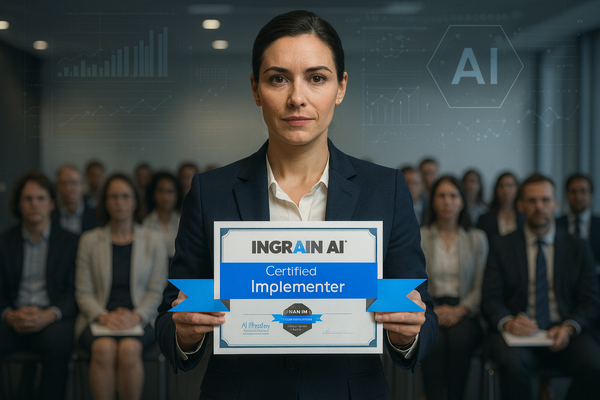
The Ingrain AI™ Certified Trainer Program was built for professionals who are done waiting to be recognized and ready to step forward with proof. It’s for the ones who are already applying AI but need the credibility to match their capabilities.
Inside the program, you’ll go deeper than tools. You’ll learn how to lead implementation, guide ethical use, structure enterprise AI frameworks, and build confidence in your ability to teach others how to think, not just execute. You’ll be equipped to lead teams, guide clients, and support decision-makers with a level of clarity that cuts through confusion.
You’ll walk away certified, with a framework. And you’ll walk into the next conversation already trusted.
If you’re serious about building real AI marketing credibility, this is where you start. Apply now.