Your Employees Are Telling You Where AI Needs Work
Employee complaints about AI aren't resistance to change. They're a diagnostic signal, and most leaders are reading them wrong.
AI readiness is the difference between how many employees use an AI tool and how many trust it, understand its limits, and can catch its mistakes. That difference is where most AI investments quietly fail. Harvard Business Review research found a sharp split inside most companies: 45% of executives report strong returns from AI investments, but only 27% of middle managers say the same.
Executives use AI for strategy and drafting, where it delivers fast wins. Managers absorb the harder parts: unreliable outputs, extra review work, and employees worried about job security. That split helps explain why 43% of workers expect AI to make their jobs more frustrating, and 53% worry it will affect their job security.
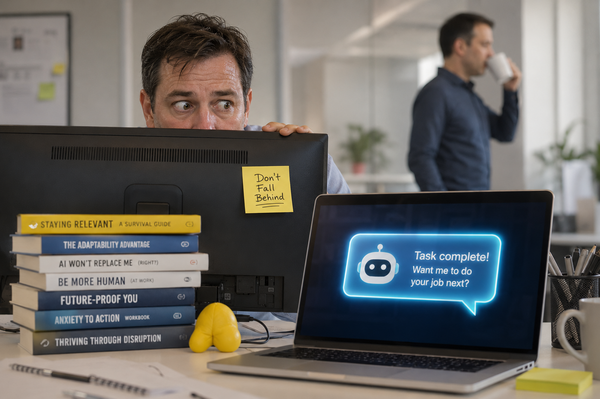
Listen when someone complains that an AI tool added three steps to a task that used to take one. Watch what happens when a manager quietly checks every AI-generated answer because getting one wrong could land on their desk. Notice the tension when employees hear another announcement about AI productivity and wonder if greater productivity eventually means fewer people.
Those reactions are easy to dismiss as resistance to change. Doing so could be a costly mistake.
More than 80% of business leaders in that same study reported using AI weekly. A strong majority plan to increase investment, and 74% reported perceived positive returns from early deployments. Yet fewer than 10% of companies are capturing meaningful AI value at scale.
Buying more AI tools won't solve this problem. Approving a larger budget won't solve it either. Telling employees that AI is now a priority won't guarantee meaningful results.
People inside your company still have to turn that investment into better work. They run into awkward workflows, unreliable outputs, unclear expectations, missing skills, and added responsibilities that rarely show up in an executive presentation. When something goes wrong, those employees often absorb the extra work required to fix it.
Fear can expose uncertainty about roles and job security. A frustrating workflow usually means it needs to be redesigned, and hesitation often points to missing skills, poor training, or an AI use case that just isn't ready yet.
Treat those signals as business intelligence.
Listen Before You Push Harder
Is Employee Resistance to AI a Warning Sign You're Missing?
Yes. Employee frustration with AI often points to a specific, fixable problem, not unwillingness to change.
When an employee says AI is making work harder, your first instinct may be to assume they need more training, encouragement, or time with the technology. Resist that instinct.
Their frustration may be showing you something more valuable. An AI tool might be creating extra review work. A workflow could require employees to jump between systems just to complete a simple task. Managers may be spending hours checking outputs, correcting errors, answering questions, and calming employees who are worried about what AI means for their jobs.
Two groups inside the same company can look at the same AI shift and see very different realities. For example, 56% of executives in the Harvard study believed their companies were adopting AI much faster than competitors. Only 28% of middle managers agreed. Middle managers operate much closer to the daily consequences of AI implementation. They see the employee struggling to get consistent results, hear complaints about another new process, and know when an AI-generated answer has to be checked, rewritten, or thrown away.
That distinction helps explain why an owner can feel excited about AI while an employee feels exhausted by it. Ignoring that exhaustion is dangerous.
Often, it's because repeated corrections mean the technology is being asked to do work where the accuracy bar is higher than what it can currently hit.
Business owners should create ways for employees and managers to report what's working, what's failing, and where AI is adding work instead of removing it. The Harvard article specifically recommends structured upward feedback channels where cautious assessments and failed pilots are treated as useful data rather than resistance.
Stop asking only how many employees are using AI. Start paying attention to what happens after they use it.
Stop Adding AI Work to People Who Are Already Overloaded
Why Doesn't AI Adoption Save Time Right Away?
Because implementing AI well takes time before it saves time, and most companies skip that step.
Imagine telling an already stretched manager that AI is going to save hours every week. Then you ask that person to attend training, test new tools, redesign workflows, teach employees how to use them, check AI-generated work for errors, document new processes, and keep normal operations running. The promised time savings can feel painfully distant.
When AI fails, someone has to clean up the mess. A summary needs to be checked. Customer communication needs to be rewritten. Incorrect information has to be caught before it leaves the company. That work has a cost. For an employee who's already overloaded, another AI initiative can feel less like help and more like another responsibility dropped onto an overflowing desk.
Managers face even more pressure. Harvard found that managers typically spend less than 30% of their time on talent and people leadership. Nearly half of their time is consumed by administrative work and individual contributor responsibilities. At the same time, those managers are being asked to help employees learn new tools, change established workflows, test AI applications, and eventually manage teams where people and AI systems work together.
AI can eventually remove repetitive work. Status updates, meeting summaries, and routine communications are all examples where generative AI may return valuable time to managers. Capturing those benefits, however, requires an investment of time before the savings arrive.
Before assigning another AI initiative, look at what's already consuming your employees' time. Identify repetitive administrative work that can be reduced first. Give managers enough capacity to test new processes carefully. Stop treating every complaint about added workload as reluctance to change.
Measure Readiness Before You Celebrate Adoption
Does Using AI Every Day Mean Your Team Is Ready for It?
No. Usage tells you employees touched the technology. It doesn't tell you if they trust it, understand it, or can catch its mistakes.
A dashboard showing rising AI usage can make progress look impressive. More employees are logging in, teams are experimenting with prompts, training sessions are filling up. Those numbers tell you AI is being used. They don't tell you if your people are ready to use it well.
The Harvard study argues that companies need to measure readiness, not simply adoption, by examining skills, capabilities, employee attitudes, and manager confidence.
An employee might use AI every morning and still lack confidence in the output. Someone else may know how to write an effective prompt but have no idea when sensitive company information should stay out of an AI system. A manager could encourage an entire department to use AI without knowing how to evaluate if the resulting work is accurate.
Fear changes behavior. An employee who believes AI threatens a job may avoid experimenting with it. Another may use the technology because management expects it while quietly distrusting the results. Some people may rush to automate tasks without understanding the risks because they believe demonstrating AI proficiency will protect their careers. Each employee counts as an AI user. None of those behaviors should automatically count as successful AI adoption.
Start asking if employees understand where AI should be used and where human judgment remains critical. Determine if they can recognize inaccurate or misleading output. Make manager confidence and organizational readiness explicit KPIs alongside usage metrics.
Instead of celebrating because 80% of employees used an AI tool this month, ask better questions:
How many know how to verify its work?
Which departments understand appropriate use?
Where are employees losing time?
Which roles feel most threatened?
What skills are preventing people from getting better results?
Answers to those questions expose where your next investment belongs.
Turn Employee Fear Into an AI Action Plan
How Do You Turn Employee Complaints Into an AI Action Plan?
Start by diagnosing what's behind the complaint before choosing a fix.
Harvard recommends that leaders diagnose their organizations before prescribing solutions: determine if managers and employees understand the AI vision, identify areas that are more prepared or resistant, and evaluate conditions before pushing ahead.
Different problems require different responses. Training won't fix a poorly chosen use case. Another AI platform won't solve unclear expectations. Increased adoption targets won't calm employees who believe they're being trained to replace themselves.
Start with the work itself. Identify tasks that consume significant employee time: repetitive processes, communication bottlenecks, manual research, administrative work, activities where employees repeatedly move information between systems.
Then look at the human side of it. Find out where employees already feel confident using AI, which roles feel exposed, what skills are missing, and where managers are struggling to give guidance. Look at which teams are experimenting successfully and figure out what's working for them.
The HBR authors also recommend involving managers in AI planning before major decisions are made, reducing workload before adding new responsibilities, and creating upward feedback channels where failed pilots and cautious assessments become useful information rather than evidence that employees are unwilling to change.
People will stop telling you what's wrong if every concern is treated as negativity. Once that happens, leadership loses access to some of its most valuable AI intelligence. Problems remain hidden until they appear as wasted spending, poor output, employee frustration, security concerns, customer issues, or disappointing returns.
Successful AI adoption shouldn't be measured by how much AI you can force into a company. Measure it by whether the technology helps people do valuable work better and produces business results worth the investment.
Not sure which of your employees' complaints point to something you can fix, and which point to skills your team hasn't built yet? The AI Impact Report gives you a clear read on where AI is creating value in your organization, and where it's quietly costing you, before your next budget decision.