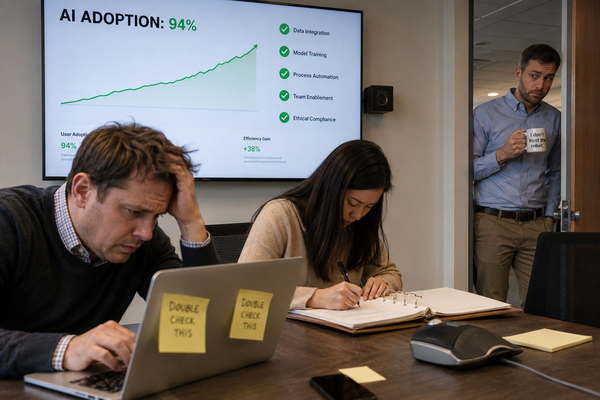
Most AI usage dashboards measure participation, not results.
You won’t see whether the work coming out is any good, if managers trust what they're building, or if the tool changed how the job gets done. That's why executives feel good about their AI investment while the managers running day-to-day operations don't.
Manager confidence, skill depth, workflow integration, and upward feedback flow are the 4 numbers that close that disconnect. None of them show up on a standard usage report, yet all 4 determine whether an AI investment turns into real business results or just an expensive habit.
Here's what happens next if you keep tracking the wrong thing: your usage numbers stay healthy, the leadership team stays confident, and six months from now you're blindsided by results that never matched what everyone promised. Adoption tells you people showed up, but it says nothing about whether they're ready, capable, or supported.
1. Manager Confidence
Why do managers stay privately unconvinced about AI?
In most organizations, they show up as active users while quietly avoiding the tool for anything that matters.
Research on enterprise AI adoption from the Wharton School and GBK Collective found that only 39% of middle managers say they've become more positive about generative AI over the past year, compared to ~2/3 of executives. Nearly 1/2 of managers describe themselves as cautious. That caution comes from earned experience, not resistance to change. Managers watch the tool underperform in high-stakes, day-to-day situations where mistakes cost something real, a far cry from the polished demos executives usually see.
Confidence predicts everything that follows:
A manager who trusts the tool pushes their team to use it well and works through problems instead of quietly giving up on it.
A manager who stays privately unconvinced lets the tool sit mostly unused, while still logging just enough activity to avoid standing out on a usage report.
These two managers look identical on a dashboard but produce completely different results for the business. Track confidence directly, or keep guessing at why results never show up on schedule.
2. Skill Depth Not Login Frequency
Why doesn't login frequency predict skill?
An employee logging in daily tells you almost nothing about what they're producing. Some spend that session drafting sharp, usable work in minutes. Others spend the same time fighting the tool, running the same request 5 different ways, then giving up and writing it themselves anyway. Both show up identically in your adoption report as a daily active user.
The Wharton School and GBK Collective found that more than 80% of business leaders report weekly AI use, a number that climbed sharply year over year. The same research found that fewer than 10% of companies capture meaningful AI value at scale; echoed by separate studies from BCG, McKinsey, and MIT. High usage and low value showed up in the same data set, at the same time, inside the same organizations.
The reason comes down to what each group does with the tool. Senior leaders tend to use AI for synthesis and strategic drafting, tasks the technology handles well out of the gate. Daily operations are messier: workflows built over years, output that has to be consistently correct rather than just fast, and wildly uneven comfort levels across the team. A high login count from that second group can mean the tool gets used constantly and still never produces work good enough to ship without a full rewrite. Measure the difference, or keep mistaking motion for progress.
3. Workflow Integration
How do you know if AI changed the workflow?
A tool that sits next to your existing process instead of inside it creates extra work disguised as progress. Employees open the AI tool, generate something, then copy it into the same old system and file it away the same old way. The tool gets used, but the workflow never changes.
This happens because most organizations hand employees an AI tool without ever redesigning the process around it, and managers rarely get the bandwidth to fix that alone. Managers typically spend less than 30% of their time on the talent and leadership work AI initiatives depend on, with nearly half of their time consumed by administrative tasks and individual contributor responsibilities. Hand someone a new tool without freeing up time to rebuild a workflow around it, and the tool gets bolted on instead of built in.
Ask three questions to check for real integration:
Does a task that used to take five steps now take three, with AI absorbing two of them completely?
Has a report that used to take a full afternoon shrunk to twenty minutes, with the extra time going toward analysis instead of formatting?
Or does the AI-generated draft still get manually retyped into the same old template before anyone considers the work done?
That third pattern shows up constantly, and it explains why so many companies report high usage alongside flat productivity. Measure the change directly, or keep paying for a tool that never earned its place in the actual work.
4. Upward Feedback Flow
Why don't AI problems reach leadership?
Executives at most companies believe their AI rollout works well, because the only information reaching them says so. Nobody wants to be the person who reports a failed pilot. Middle managers absorb that pressure quietly, and problems that could get fixed early sit buried until they show up as missed targets months later.
The Wharton School and GBK Collective found that 56% of executives believe their organization is adopting AI faster than competitors, while only 28% of middle managers agree. That's two groups working from entirely different information, because ground-level reality rarely travels back up the chain in an honest form.
This one is harder to fix than the other three. Confidence and skill depth can be surveyed. Workflow integration can be observed. A working feedback loop has to be built and defended on purpose: a channel where a manager can report that a pilot failed, and where that report changes something instead of disappearing. Companies that build it catch problems while they're still cheap to fix. Companies without it find out the same information eventually, just after a budget cycle has closed and the cost has multiplied.
Ask a simple question to check whether yours exists: when was the last time a manager reported that an AI tool failed at something, and what happened to that report afterward? If the honest answer is nothing, the feedback loop doesn't exist yet, no matter how healthy the adoption dashboard looks.
Adoption Tells You Who Showed Up. Readiness Tells You What Happens Next.
Four numbers determine whether an AI investment turns into real business results: manager confidence, skill depth, workflow integration, and upward feedback flow.
Owners who keep tracking adoption alone will keep getting surprised. High activity and low value show up together far more often than anyone expects, and the difference almost always traces back to those four readiness factors instead of the technology itself.
The AI Impact Report measures exactly what your usage dashboard can't see. Get a clear picture of where your organization stands, and start making decisions based on readiness instead of guesswork.