
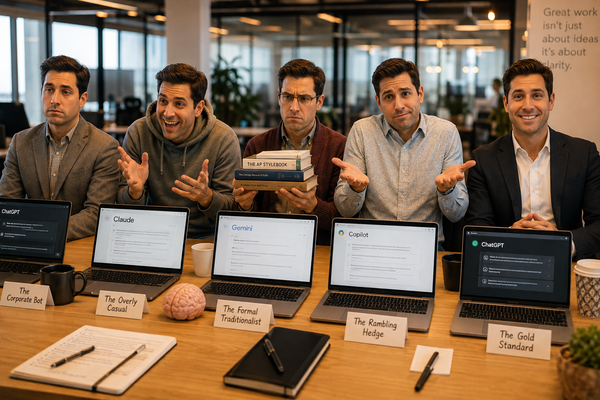
Untrained prompting is quietly rewriting your brand, one message at a time.
When staff prompt AI on their own, with no shared standard, the tone of your emails, proposals, and support replies shifts depending on who typed the message. Customers notice the inconsistency even when they can't name it, and it shows up as lost trust and stalled deals. The fix isn't banning AI or buying more licenses. You need to train your team to prompt from one shared method, so the output sounds like a single company no matter who's at the keyboard.
Your brand voice took years to build. It survived rebrands, staff turnover, and a dozen marketing consultants who each wanted to "modernize" it. Then, AI walked in the door, and it started drifting without anyone noticing.
One employee started using ChatGPT to draft client emails last spring. Another picked it up for internal memos over the summer. By now, most of your team is leaning on AI daily, and each person is prompting it differently. Some type in full sentences, others paste in bullet points, a few copy your old brand guidelines into the prompt, and most don't bother at all.
The result is a business that sounds like 5 different companies depending on who hit send. Your sales team sounds confident and sharp. Your support team sounds flat and apologetic. Your marketing emails read like they came from three agencies in three decades, because in a sense, they did.
How Much Is Inconsistent AI Prompting Actually Costing You?
Why does one company end up sounding like 5 different companies?
Every employee who prompts AI without a shared standard makes a small, invisible decision about who your company is that day. This quiet adoption has already reached most of the workforce, and it happened without a policy, training session, or company announcement.
A customer emails your support team on Monday and gets a warm, patient reply that walks them through their issue. That same customer emails again on Thursday, a different rep answers, and the tone shifts to clipped and transactional. That whiplash means:
Trust erodes through broken pattern recognition. People expect a consistent experience from your brand. When it shifts unpredictably, confidence drops even if the customer can't explain why.
Inconsistency reads as risk in B2B sales. A prospect who gets a sharp proposal from one rep and a hedging one from another doesn't conclude two people wrote it. They conclude your company is unpredictable, and unpredictability is the fastest way to lose a deal that was otherwise ready to close.
Marketing spends months and real budget shaping brand identity, then watches it dilute across hundreds of AI-generated touchpoints that never passed a consistency check. This shows up as a slow decline in close rates, not one dramatic loss.
Why doesn't one skilled employee's prompting habit spread to the rest of the team?
Your best salesperson might already be great at prompting AI. They've experimented for months and developed an instinct for sharp output on the first try. That skill lives entirely in their head, and it disappears the moment they're out sick, on vacation, or gone to a competitor. Individual mastery doesn't transfer or scale.
Most business owners assume the fix is simple: let capable employees keep doing what works and let everyone else catch up on their own time.
That fails because skilled prompting isn't one universal technique that spreads by osmosis. It's dozens of situational judgment calls, how much context to include, which tone words to use, when to revise versus start over, and those calls vary wildly person to person. Fifty employees prompting without a shared method produce 50 separate interpretations of what your company sounds like.
The math worsens with headcount.
A 10-person team with inconsistent prompting creates a manageable mess that a sharp manager might catch. A 300-person company creates thousands of customer touchpoints a week, each one a small bet on whether that employee happened to prompt well that day. No manager can review that volume, and no amount of individual talent closes that distance. Scale exposes the flaw rather than covering it up.
What Does a Trained, Shared Prompting Method Actually Look Like?
Sales teams learn a proven pitch structure, support teams learn a tone guide before touching a live ticket, and new hires get onboarded into shared standards long before they manage a customer relationship. So, why has AI prompting skipped this step at most companies? Instead, it’s treated as a personal productivity trick rather than a skill that earns the same rigor as everything else your team trains on.
That's the specific problem Scalable Prompt Engineering™ was built to solve. Instead of leaving employees to develop private habits through trial and error, it offers a shared, repeatable method for prompting AI that holds up across departments, roles, and use cases. Sales, support, marketing, and operations all work from the same foundation, so the output sounds like one company instead of five.
It teaches the structure behind a strong prompt:
How to give AI the right context for the specific task and audience
How to specify tone so output matches the brand, not the individual
How to revise output until it genuinely sounds like your company
A rep who learns this method gets better in a way that matches everyone else who went through the same training, which is the entire point.
The Voice Your Customers Hear Is the Brand You're Actually Building
Every unmanaged prompt is a small decision about who your company is that day. Multiplied across every employee and every touchpoint, that adds up to a business rewriting its own identity dozens of times a week, with nobody signing off on the changes.
You didn't build your brand by accident, and you shouldn't let AI unbuild it by accident either. The fix requires treating prompting like the skill it is, not a personal quirk each employee figures out alone. A trained, shared method gives your team one voice to work from, regardless of who's typing.
Ready to go further? Schedule a conversation with us and find out what it takes to get your entire team prompting AI like they work for the same company.