
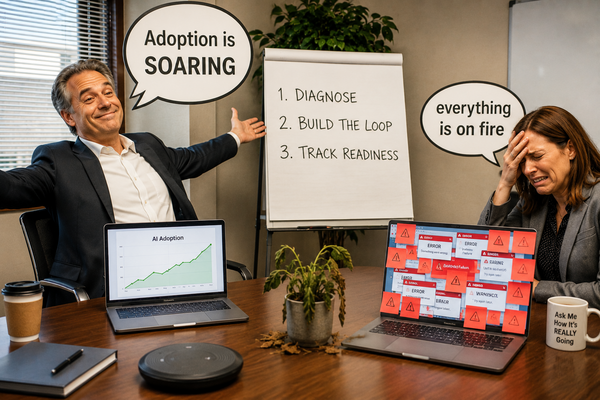
Before you roll out another tool, fix the conversation that decides whether any of it sticks.
Nearly 1/2 of executives believe their company's AI investment is paying off.
Among the managers running the day-to-day work, barely 1/4 agree. That split is the reason AI rollouts stall inside otherwise well-run companies: leadership is optimistic, the front line is quietly skeptical, and nobody built a system to bring the two sides together. This is a feedback practice for any new leader inheriting or building an AI rollout, and it solves the trust divide between executives and managers before it costs the budget. Fix this one AI workflow first, before adding another tool, course, or mandate.
Most new leaders inherit a rollout instead of building one. The dashboards are already live. The licenses are already paid for. Someone above you announced it in a meeting six months ago. What's missing is the one workflow that tells you if any of it is working.
The people at the top of most companies believe AI is delivering results. The people managing daily work often don't. Neither side is lying. They're looking at two different jobs through two different lenses, and the rollout keeps moving forward on executive optimism while the managers running it quietly lose faith, one frustrating workaround at a time.
If you're stepping into a leadership role right now, whether you're running a five-person marketing team or you just took over operations at a growing small business, you don't get to wait for someone else to fix this. The workflow that surfaces the truth about how AI is landing on your team has to exist before you add anything new. Skip it, and you'll spend the next year guessing.
Building the habit of checking in before you scale up matters more than any new technology you bring in. That habit starts with understanding exactly where the disconnect between leadership and the front line tends to show up.
How big is the disconnect between executives and managers on AI?
Have you ever sat in a leadership meeting nodding along about a tool you personally knew your team was still avoiding? That silence in the room is expensive. It's why budgets get approved for things that never get used, and why leaders wake up a year later wondering why the change they promised the board never showed up in the numbers.
The researchers point to something deeper than stubbornness or resistance to change. Executives spend their time on strategy and big-picture thinking, work AI genuinely excels at supporting. Managers spend their time inside messy, hands-on workflows built over years, where a single hallucinated answer or broken handoff creates real damage they have to clean up personally.
If you walk into your role assuming your optimism about AI is shared by the people executing your plans, you're planning around a level of buy-in that doesn't exist.
How do I know if my team trusts our AI tools?
You find out by diagnosing before you deploy anything else.
A new leader's first instinct is almost always to add something: a tool, a training session, an adoption target. That instinct feels productive, but it rarely is. Leadership teams need to diagnose where their organization stands before they add any new tool, training, or mandate. You can't fix a disconnect you haven't measured, and without that measurement, a leader's own enthusiasm can quietly distort their read on how ready the team really is.
This names a mistake nearly every new leader makes without realizing it. You inherit a rollout, feel pressure to show quick wins, and start pushing adoption before you've asked one honest question about what's happening in the day-to-day work. A team still confused about basic use cases doesn't need a new tool. It needs someone to sit down and figure out what's really going on first.
Diagnosing readiness doesn't require a formal survey or an outside consultant. It can be a short, recurring check-in built into your existing one-on-ones or team meetings, where you ask direct questions:
What's working right now?
What feels like a waste of time?
What are people quietly avoiding because it doesn't fit their actual workflow?
Those answers rarely match the confident story a leader tells themselves about how the rollout is going. That disconnect is exactly the information you need before you spend another dollar.
Building this diagnostic habit early protects a new leader from the most common trap in AI adoption. Once you know where your team genuinely stands, every decision after that gets sharper, faster, and far less likely to waste the budget you've been trusted to manage.
How do I get honest reporting on AI adoption instead of good news?
You build a channel that treats a failed pilot as data, not as a problem to hide.
Trust breaks quietly in most AI rollouts, one unreported failure at a time. Harvard Business Review research lands on a recommendation new leaders can act on immediately: build structured channels that let managers report the real state of AI adoption upward. The authors stress something most leadership teams get backwards: a cautious report or a failed pilot isn't a sign of resistance. It's valuable data, and treating it as anything less trains people to stop being honest with you.
A working feedback loop doesn't need to be complicated to be effective. It can be a recurring 5-minute slot in your team meeting reserved specifically for what broke, what got abandoned, and what nobody's talking about yet. It can be an anonymous form sent monthly asking people to rate their confidence with the tools they've been given.
Some new leaders assume this problem is already solved because a feedback channel technically exists: an engagement survey, an open-door policy, or a suggestion box nobody uses. Those channels usually miss this trust issue because they're built to measure general satisfaction, not confidence in a specific AI workflow, and they rarely produce a visible response people can point to. A generic survey tells you people are "mostly satisfied." It doesn't tell you that half your team quietly stopped trusting the tool three weeks ago. The format matters less than the follow-through. When someone flags a problem, they need to see you respond to it visibly, not file it away and move on.
For a small business owner or marketer stepping into a leadership seat, this loop becomes your early warning system. It catches quiet failures before they turn into a wasted budget line or a team that's given up on a tool they never understood in the first place. Skipping it doesn't make the problems disappear. It just means you find out months later, from someone else, after the damage is done.
How do I measure AI readiness instead of just usage?
You track confidence alongside usage, not usage alone.
Usage numbers can climb while confidence quietly collapses, and most leaders never notice until it's too late. But tracking adoption alone misses the real story. A leader who only watches login counts or feature clicks has no way of knowing that the people behind those numbers feel lost, overwhelmed, or one bad week from quitting the tool entirely.
This gives a new leader something concrete to measure, instead of relying on a feeling that things seem fine. Readiness is a real, trackable thing. It includes:
People understanding what the tool is for
Trusting that the output enough to use it on real work
Feeling supported enough to ask for help instead of quietly giving up
None of that shows up in a usage dashboard, which means most leaders are flying without the instrument that predicts if their investment pays off.
Turning readiness into a number doesn't require anything elaborate. A simple quarterly pulse check works. Ask your team to rate their confidence using the tool on a scale of 1-5, ask them how often they trust the output without double-checking it, and ask what would need to change for that number to go up. Track those scores next to your usage metrics, side by side, and watch for the moments where usage climbs but confidence doesn't. That combination is the clearest signal you'll get that people are using a tool out of obligation, not because it's working for them.
For a small business owner or marketer building an AI strategy from scratch, this habit makes the difference between a rollout that looks successful on paper and one that genuinely earns its keep. Track it, and you'll know which one you actually have.
Here's the AI workflow, start to finish
Week 1 — Diagnose. Add a recurring check-in to your existing one-on-ones or team meetings. Ask what's working, what feels like a waste of time, and what people are quietly avoiding. Don't add any new tool or mandate until you've done this at least once with every person on your team.
Week 2 — Build the loop. Stand up one reporting channel: a 5-minute slot in your team meeting for what broke and what got abandoned, or a short anonymous form. Pick one, not both. Announce that a failed pilot counts as useful data, and then prove it by visibly acting on the first thing someone reports.
Ongoing, every quarter — Track readiness. Run the confidence pulse check: rate tool confidence 1-5, ask how often people trust output without double-checking it, and what would move that number. Log it next to your usage metrics so you can see the two lines split if they do.
The first 2 steps are a one-time setup. The third repeats. Once the loop is running, the quarterly check tells you whether it's working.
Fix this one workflow first
Fixing this one workflow won't finish your AI strategy, but it will stop it from quietly failing in the background. The rollout you inherited, or the one you're about to build, depends far less on the tool you pick than on knowing what's happening once your team starts using it.
Diagnose before you deploy. Build a loop that rewards honesty instead of punishing it. Track readiness the same way you track usage. Do those three things consistently, and you'll catch the problems while they're still small enough to fix.
Curious where your own team stands? See where you fall on the 10 Levels of AI Mastery.