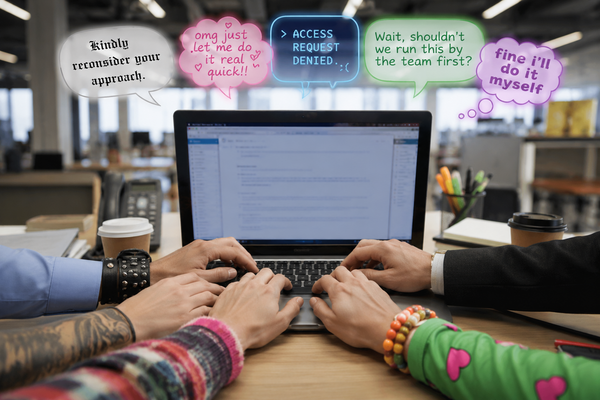
Your team is using the same tool, yet producing content that sounds like it came from 5 different companies. Here's why that's happening and what it's costing you.
When your team prompts AI without a shared structure, each person guesses at tone, formality, and word choice on their own.
AI doesn't invent your brand voice. It reflects whatever instructions it's given, so 5 different sets of instructions from 5 different people produce 5 different voices, all from one company.
Customers feel that shift even when they can't name it, and the inconsistency quietly wears down trust, burns hours in rework nobody tracks on a budget line, and leaves new hires with no reference point to learn from.
A shared prompting framework fixes this by giving everyone the same starting point for tone and structure, so the voice stops depending on who happens to be typing that day. AI SkillsBuilder® Essentials is a training course built to teach small business teams exactly this system.
Read the customer email your support rep sent this morning. Now read the LinkedIn post your marketing manager published an hour later. Then open the proposal your sales lead just sent to a prospect. Do they all have different voices, or can you tell they’re from the same brand?
This is happening inside thousands of small businesses right now, and most owners haven't noticed yet. Everyone on the team has access to the same AI tools. Everyone types their own version of instructions. Nobody agreed on tone, phrasing, or personality beforehand.
One interaction feels warm and human, while the next feels stiff and corporate. Trust erodes a little each time the voice shifts, because consistency is one of the quiet signals people use to decide whether a business is trustworthy or just winging it.
The good news: this is a structure problem rather than a people one, and structure problems have fixable answers. Here's what's driving the disconnect, and what it's costing your brand while it goes unaddressed.
Why Does My Team Sound Different When Everyone Uses The Same AI Tool?
Because nobody gave them a shared starting point. Without a prompt structure, every person on your team builds their instructions from scratch, every time, and fills the gaps with their own instincts.
It's tempting to blame the people. Maybe your support rep types too casually or your marketing manager overcorrects into stiff, polished copy because she doesn't trust her own voice. Maybe your sales lead just wants to close the deal and doesn't think twice about tone. None of them woke up trying to fragment your brand. They're each doing the only thing they know how to do, which is guess.
Picture a customer who emails your business twice in one week with two different questions. The first reply sounds warm and personal. The second sounds like it was pulled from a legal disclaimer. That customer doesn't think "different employee, different style." They think something feels off, even if they can't say why.
The fix isn't asking your team to try harder. Everyone needs the same starting point. A shared structure means everyone's tone matches, no matter who's typing.
Is Inconsistent AI Output Hurting My Customer Relationships?
Yes, and the damage won’t show up all at once. Trust is built on pattern recognition, and when your voice breaks that pattern unpredictably, customers register it even if they can't explain what changed.
Small businesses can't absorb this the way larger companies can. Formally trained employees are 2.7x more proficient with AI than self-taught peers (a problem that access to more tools alone doesn't close), and this shows up directly in how consistent your customer-facing content feels. A single jarring interaction can undo months of relationship building, especially with new customers who haven't yet decided whether to trust you at all.
What Is Guesswork-Based AI Prompting Costing My Business?
More than you can see on a spreadsheet. Payroll, software subscriptions, and marketing spend all show up where anyone can track them. The cost hiding inside unstructured AI use doesn't.
Here's where it adds up:
Repeated setup time. Every employee spends a few minutes coaxing the right tone out of an AI tool before sending a single email, every day, with nothing reusable produced and no memory passed to coworkers.
Invisible customer costs. A stiff, off-brand email to a frustrated customer can trigger a follow-up call, a complaint, or a lost renewal that never gets traced back to its actual cause.
Rework friction. When output sounds off, someone has to notice it, rewrite it, and approve the fix. That's three people touching one piece of content that should have taken one person/ attempt.
72% of organizations have AI tools in place while 55% lack the training to go with them. The tool isn't the problem, the space between the tool and the person using it is.
Speed without structure doesn't save time. It just means mistakes happen faster and more often. Small businesses that let every employee guess at their own prompts are deferring the cost of that inconsistency to a moment when it's harder and more expensive to fix.
What Does A Shared Prompting Framework Fix?
It removes the guesswork at the exact point where inconsistency starts. Instead of 5 employees inventing 5 sets of instructions, everyone works from the same foundation, and tone, formality, vocabulary, and structure get defined once instead of reinvented daily.
A support rep no longer has to decide, on the spot, how formal a reply should sound. A marketing manager doesn't have to reinvent the brand's personality every time she opens a new chat. The framework already answered those questions, so the human only fills in the specific task in front of them.
Correction gets faster too. When something sounds off, the fix isn't a vague note like "make it sound more like us." It's a specific, shared reference point anyone on the team can check against, which turns a fuzzy problem into something concrete and fixable in minutes.
Maybe you've tried a training push before and watched it stall. That's a fair reaction, and it's worth naming directly: most AI training fails not because the content is wrong, but because it teaches skills without giving the team a shared structure to apply them inside. A framework built into the training itself, rather than left for each employee to build alone, is what makes the difference hold past the first few weeks.
New hires benefit most of all. They don't need months to absorb the company's voice through trial and error. They inherit the same structure everyone else uses on day one. Growth stops multiplying inconsistency and starts multiplying capability instead.
How Do I Build A Brand Voice That Doesn't Depend On Guesswork?
Start by giving every employee the same starting point before they open an AI tool at all. That's not a matter of hiring more careful people or hoping everyone lands on the same tone naturally.
A shared framework replaces guesswork with structure, turns correction into a fast process, and lets new hires absorb the brand voice on day one instead of months into the job.
AI SkillsBuilder® Essentials walks small business teams through building reusable prompts, using containers, delimiters, and variables, so tone and structure stop depending on who's at the keyboard. Teams that complete it walk away with a working system they can apply right away.
If your brand voice has started to feel like it's coming from five different companies, see the exact framework AI SkillsBuilder® Essentials uses to standardize prompts across a team, and give your people the shared foundation they need to sound like one business, every time.