Scalable Prompt Engineering™ is a structured system for teaching every person on your team to communicate with AI tools in a way that produces consistent, high-quality output, regardless of role, experience level, or which tool they're using.
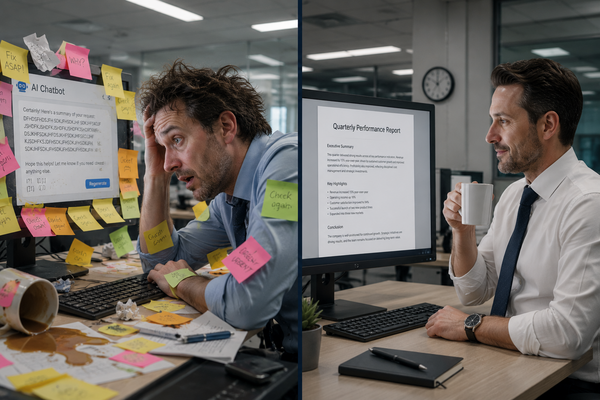
Most business teams already have AI access. The problem is that results vary wildly depending on who's using the tools. One person pulls a polished strategy document from ChatGPT in ten minutes. Another spends an hour and gets something unusable. That inconsistency compounds.
The fix is a shared framework: a common language for how your people structure requests to AI, built around the specific tasks your team does every day. When prompting is taught as a discipline, standardized across roles, and captured in reusable templates, AI output stops depending on individual talent or patience. Consistent inputs produce consistent outputs. That's what scalable means, and it's the difference between a handful of people getting value from AI and your entire organization doing it reliably.
What Prompt Engineering Means (and What It’s Not)
Most people's first experience with a tool like ChatGPT goes something like this: type in a question, read what comes back, decide if it's either useful or not, and move on. That's a reasonable starting point. It's also about as far from prompt engineering as winging a sales call is from running a structured sales process.
Prompt engineering is the practice of structuring your communication with an AI model in a way that consistently produces high-quality, useful output. It's not a trick or a workaround. Think of it as a skill, and like most skills, it's learnable, repeatable, and improvable over time.
A well-engineered prompt doesn't just ask a question. It gives the AI a role to play, a problem to solve, a format to follow, constraints to work within, and context that shapes the response. The difference between a vague prompt and a well-built one can mean the difference between a paragraph of generic text and a finished first draft your team can use.
What Does a Well-Built Prompt Actually Include?
Think about the last time you asked an AI tool for help and got something that missed the mark. The output probably wasn't wrong because the AI is bad at its job. It was wrong because the AI didn't have enough information to do the job you needed done.
A structured prompt solves that by including several components that most people skip. You're telling the AI who it's supposed to be in this context, what audience it's writing for or speaking to, what the output should look like, what it should and shouldn't include, and what success looks like for this particular task. When all of those pieces are in place, the AI isn't guessing. It's executing against a clear brief.
The AI SkillsBuilder® Essentials course is built around this exact idea. It teaches participants how to move beyond ad hoc prompting and into structured, intentional communication with AI tools that produces reliable results across different tasks and business contexts.
What Does It Mean for Prompt Engineering to Be Scalable?
Here's what's common in most organizations right now: a handful of people have figured out, mostly through trial and error, how to get good output from AI. They've developed their own mental models, prompt habits, and workarounds. And those insights live entirely in their heads.
Everyone else on the team is starting from scratch every time they open the tool. They're reinventing the wheel on every task, getting inconsistent results, and quietly concluding that AI either isn't that useful for their specific work or requires some kind of special aptitude they don't have.
Neither conclusion is true. What's missing is a framework. And that's exactly what prompt engineering, taught and practiced as a discipline, gives your team.
What Does It Mean for Prompt Engineering to Be Scalable?
Why Does It Matter If Only a Few People on Your Team Are Good at This?
There's a version of AI adoption that looks like success from the outside but isn't. A few high performers figure out how to get great results from AI tools. Leadership points to them as proof the investment is paying off. Everyone else keeps struggling quietly, and the organization never closes the distance between what's possible and what's happening on the ground every day.
That's just a handful of individuals with good instincts and enough patience to experiment; and it doesn't scale.
Scalable Prompt Engineering is the difference between one person knowing how to get great AI output and your entire team having a reliable system for doing it. When prompting is taught, standardized, and built into how your team works, the quality of AI output stops depending on who happens to be using the tool that day. Consistent inputs produce consistent outputs across departments, roles, and experience levels.
Your Team Already Has AI Access. Why Isn't That Enough?
Most organizations have already solved the access problem. Licenses are purchased, tools are available. The issue is that access without a shared framework produces exactly what you'd expect: wildly uneven results that reflect individual experimentation more than organizational capability.
Middle managers feel this most acutely. They're the ones who have to make AI work in the reality of day-to-day operations, with teams that have uneven comfort levels, workflows built over years, and output that has to be consistently right. When those managers don't have a shared structure for how to use AI effectively, the optimism at the top of the organization rarely makes it to the people doing the actual work.
Scalable prompt engineering directly addresses that. When your team has a common language for how to communicate with AI tools, a library of tested prompt structures for the tasks they do most, and training that closes the skill divide across the board, the inconsistency that undermines AI investment starts to shrink.
Want to see exactly what this looks like for a business team? Watch a quick overview of AI SkillsBuilder® Essentials, including what's covered, who it's built for, and what your team walks away with.
What Does It Take to Build This Capability Across a Team?
On the other hand, scalable doesn't mean everyone takes a one-hour course and suddenly produces great AI output. Building this capability across a team requires three things working together.
First, your people need to understand the underlying logic of how AI models respond to different kinds of input. Second, they need hands-on practice applying that logic to the actual tasks they do in their roles. Third, the organization needs to capture what's working, in the form of tested prompt templates and use-case-specific frameworks, so that individual learning compounds into shared institutional knowledge.
Without all three, you're back to relying on individual initiative. Some people will figure it out. Most won't have the time or the inclination to experiment their way to competence. The AI SkillsBuilder® Essentials course is designed to give teams all three, in a format that fits into a working schedule without requiring anyone to stop doing their job to learn a new one.
What Does Scalable Prompt Engineering Look Like on a Real Team?
What Is a Prompt Template and Why Does Your Team Need One?
Most people write prompts the way they write text messages: off the cuff, in the moment, shaped by whatever they happen to remember about the task at hand. That works sometimes. It fails often enough to be a real productivity drain, and it produces the kind of inconsistency that makes AI feel unreliable to the people using it most.
A prompt template is different. It's a reusable structure built around a specific task your team does repeatedly. It captures the role the AI should play, the context it needs, the format the output should follow, and the constraints that keep the response useful. Once it's built and tested, anyone on your team can pick it up and get a quality result on the first try, without needing to figure out the right framing from scratch every time.
Think about the tasks your team does most often:
Writing first drafts of client-facing communications
Summarizing meeting notes into action items
Researching competitive positioning
Drafting social content from a brief
Every one of those tasks has a repeatable structure, and every one of them can be translated into a prompt template that produces consistent, usable output across your entire team.
How Do You Know Which Tasks Are Worth Building Prompts For?
Before you can build a prompt template, you have to define the use case clearly enough that the AI knows exactly what job it's doing. That sounds obvious. In practice, most teams skip it entirely.
Use case definition means getting specific about who is using the prompt, what they're trying to produce, what the output will be used for, and what a good result looks like. It means separating the tasks where AI genuinely saves time and improves output from the ones where it adds friction without adding value. Not every task belongs in an AI workflow, and knowing which ones do is half the work.
This is where a lot of teams stall. They know AI is supposed to help, but they haven't done the work of identifying the specific, high-value tasks where structured prompting would make the biggest difference. The AI SkillsBuilder® Essentials course walks teams through exactly that process, so they come out with a clear picture of where scalable prompting fits into their actual work, not just a general sense that AI should be useful somehow.
What Happens When a Team Builds This System?
Consider a marketing team where everyone is using AI tools but getting different results. The content writer uses ChatGPT to draft blog posts and spends two hours editing every output because the tone is never quite right. Her social media manager gets decent captions sometimes and unusable ones other times, with no clear sense of why. Meanwhile, the email marketer has mostly given up on AI assistance because the outputs never match the brand voice.
Now give that same team a set of prompt templates built specifically for their use cases, each one capturing the brand voice, audience, format, and desired outcome. The content writer's first draft comes back closer to publish-ready. Her social media manager gets consistent output she can work with, and the email marketer starts using AI again because the outputs sound like the company.
Nothing about the underlying tools changed. The structure behind how the team uses them did. That's what scalable prompt engineering produces in practice, and it's the reason teams that build this capability stop treating AI as an experiment and start treating it as a reliable part of how work gets done.
How Do You Start Building This Capability on Your Team?
When Is the Right Time to Build a Prompting Strategy?
Most teams come to this conversation after they've already run into the problem. AI tools are in use, results are inconsistent, and someone in leadership is asking why the investment isn't producing more. By that point, you're fixing something that's already broken rather than building something that works from the start.
The good news is that building a scalable prompting capability doesn't require a major overhaul of how your team operates. It requires a clear starting point, a structured learning experience that gives your people a shared framework, and enough practice time to turn that framework into habit. None of that has to take months.
What it does require is treating AI prompting as a learnable, teachable skill rather than something people either have a knack for or don't. That shift in how you think about it changes everything about how you build for it.
Where Should You Start?
Before you send anyone to a course or start building prompt templates, spend an hour with your team identifying the 5-10 tasks they do most often that involve producing written output or processing information. Those are your highest-value targets for scalable prompting.
You're looking for tasks that are repetitive enough to benefit from a template, complex enough that inconsistent AI output causes problems, and common enough across team members that a shared prompt structure would save meaningful time at scale. Client communications, internal reporting, content production, research summaries, and meeting follow-ups tend to show up on nearly every team's list.
Once you've identified those tasks, you have a concrete starting point. Training becomes more focused. Prompt templates become more useful. Your team stops trying to learn AI prompting in the abstract and starts building skills around the work they do every day.
What Is the Difference Between Giving Your Team Access and Giving Them a Framework?
Access to AI tools without a framework for using them is like handing someone a professional camera and expecting great photos. The capability is there. Without the underlying knowledge of how to use it intentionally, most people will produce mediocre results and conclude the tool is overrated.
A structured training program gives your team the framework that turns access into output. It teaches the logic behind why some prompts work and others don't, builds hands-on practice around real use cases, and sends people back to their work with tested templates they can use immediately. That's the difference between a team that dabbles in AI and one that depends on it productively.
The AI SkillsBuilder® Essentials course is designed specifically for business teams making this shift. It covers the fundamentals of structured prompting, walks participants through defining and building prompts for their own use cases, and gives them a repeatable system they can carry into their daily work. If your team has AI access but inconsistent results, this is where the fix starts.
What Separates Teams That Get Real Results from AI from Those That Don't?
Access to AI tools has never been easier. What's hard is getting your entire team to produce consistent, reliable, high-quality output from those tools, day after day, across every role and every task.
Scalable prompt engineering is how you get there. It's not a technology upgrade or a software purchase. It's a capability your team builds, one that compounds over time as shared frameworks replace individual experimentation and tested templates replace guesswork.
The teams that get the most out of AI in the next few years won't necessarily have the best tools; they'll have the best systems for using them. Building that system starts with giving your people a shared language for how to communicate with AI, and the hands-on practice to make it stick.
The teams that pull ahead on AI in the next few years will not have better tools. They will have better systems for using them.
AI SkillsBuilder® Essentials gives your team a shared framework for structured prompting, hands-on practice built around your actual use cases, and tested templates they can use the same week they finish the course. Most participants complete it without disrupting their normal workload.
If your team has AI access but inconsistent results, this is where the fix starts. Register now.