
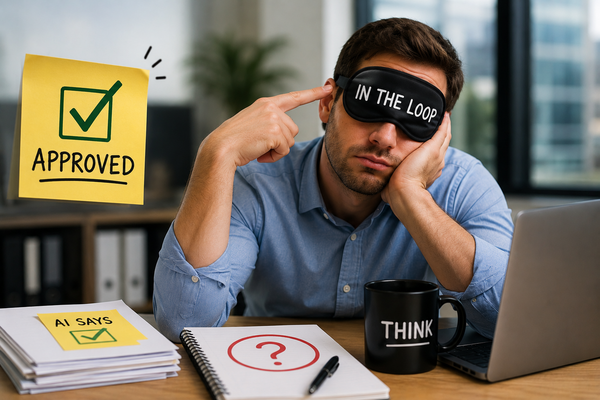
If someone on your team clicks "Approve" without recognizing a bad AI recommendation, did your governance process work?
For many organizations, that simple approval is considered enough. A person reviewed the output and a human stayed in the loop. Risk managed, right?
That assumption is getting harder to defend.
A recent IBM analysis argues that assigning a human to review AI decisions doesn't automatically create accountability. In some cases, it simply transfers liability to the employee who's expected to approve work they may not have the training, authority, or confidence to challenge.
That distinction matters because AI is becoming part of everyday business decisions. Marketing campaigns, hiring recommendations, customer service responses, financial analysis, and operational planning increasingly begin with AI generated output. Every one of those decisions still depends on human judgment.
Real AI governance means building an organization that consistently makes good decisions with AI.
Human in the Loop Was Never Meant to Carry the Entire Weight of Governance
Somewhere along the way, many organizations started treating "human in the loop" as if it were an AI governance strategy.
It isn't.
Human oversight has always been one safeguard among many. It helps reduce risk by keeping people involved in decisions that affect customers, employees, finances, and business operations. What it was never intended to do is replace the policies, accountability, and processes that make governance effective.
Think about what happens when an employee reviews AI generated content. Are they following established standards? Do they understand what risks they're expected to identify? Do they have the authority to reject questionable outputs, or are they simply expected to move work along?
Those questions have nothing to do with whether a human is present.
They have everything to do with governance.
The National Institute of Standards and Technology's AI Risk Management Framework makes this distinction clear. Human oversight is only one part of managing AI risk. Effective governance also requires clear policies, defined roles and responsibilities, ongoing risk management, and continuous improvement. The framework is designed to help organizations build trustworthy AI systems, not simply place a person between AI and the final decision.
Confusing oversight with governance creates a false sense of security. A human approval doesn't guarantee a sound decision any more than a signature guarantees someone read the document they signed.
Real governance asks whether the organization created the conditions for good decisions in the first place.
The Real Risk Is Humans Who Stop Thinking, Not the AI Itself
AI doesn't make business decisions, people do.
Every AI generated recommendation still passes through a human being before it becomes a marketing campaign, a hiring decision, a financial forecast, or a customer response. That final decision belongs to a person, even when it feels like AI did most of the work.
The problem is that people are wired to trust systems that appear knowledgeable and confident. Researchers call this automation bias, the tendency to accept recommendations from automated systems without questioning whether they're correct. As generative AI becomes more convincing, that bias becomes even harder to recognize.
Imagine your marketing manager asks AI to create a campaign strategy. The recommendations sound polished, the writing is persuasive, and the numbers even look believable.
Would anyone stop to verify the claims?
Or would they assume AI had already done the hard thinking?
That's where governance begins to break down.
IBM warns that many organizations confuse human involvement with human judgment. When employees simply approve AI generated work because it looks credible, they're no longer providing meaningful oversight. They're creating the appearance of accountability without reducing the underlying risk.
A Human Who Can't Challenge AI Isn't Really "In the Loop"
Adding a person to the approval process only works if that person has the ability to question what they're reviewing.
That's a much higher standard than simply reading the output.
Can they spot a fabricated source? Do they recognize when AI has made an unsupported assumption? Are they confident enough to push back when something doesn't seem right? More importantly, do they have the authority to reject AI's recommendation without worrying they'll be criticized for slowing things down?
If the answer to those questions is no, they're not really "in the loop."
They're simply the last stop in the workflow.
That's an important distinction because accountability requires human judgment. Employees can't exercise good judgment if they haven't been taught how AI works, where it tends to fail, or what warning signs should trigger a closer review.
This is where many organizations fall short. They invest in AI tools before investing in the people responsible for making business decisions. Without the knowledge, authority, and confidence to question AI, employees become approval checkpoints instead of decision makers.
Effective governance expects employees to challenge AI when necessary.
That's what meaningful human oversight looks like.
Governance Depends on Critical Thinking, Not Checkboxes
Policies, documentation, and approval workflows matter.
None of them can replace critical thinking.
An AI governance program is only as strong as the people responsible for carrying it out. Employees need the ability to recognize when AI is making a mistake, understand why it's wrong, and know what to do next.
That requires a different kind of training.
People need to learn how to verify facts, evaluate sources, identify bias, recognize hallucinations, and question conclusions that sound convincing but aren't supported by evidence. They should understand AI's strengths just as well as its limitations because both influence the quality of every decision AI helps make.
Many organizations focus almost entirely on teaching employees how to use AI. Far fewer teach them how to evaluate what AI produces.
There's a big difference.
Knowing how to write a better prompt may improve the first draft.
Knowing how to think critically determines whether that draft should ever be used.
The organizations that build the most trust in AI won't have the longest policy manuals or the most approval steps. They'll have employees who are confident enough to ask difficult questions, challenge questionable outputs, and make informed decisions when AI gets it wrong.
Technology will continue to evolve.
Critical thinking is the skill that makes every new AI system safer, more reliable, and more valuable.
AI Governance Starts Long Before Someone Uses ChatGPT
Many companies think AI governance begins the moment an employee opens ChatGPT or another generative AI tool.
It doesn't.
By the time someone enters a prompt, dozens of governance decisions should have already been made.
Has leadership established an AI policy? Does everyone understand which tools are approved? Has the organization defined what information should never be entered into a public model? Who owns AI decisions when something goes wrong? What standards determine whether AI generated work is ready for customers?
Those are leadership questions.
Strong AI governance establishes expectations before anyone interacts with AI. It defines acceptable use, assigns accountability, protects sensitive information, documents decision making, and creates repeatable processes that reduce unnecessary risk.
The National Institute of Standards and Technology's AI Risk Management Framework reflects this philosophy. Governance is an ongoing discipline that helps organizations identify risk, assign responsibility, evaluate outcomes, and continually improve how AI is used across the business.
Organizations that wait until AI produces an answer to think about governance have already waited too long.
The strongest governance programs don't begin with prompts, they begin with leadership.
Training Should Build Judgment, Not Prompt Memorization
Most AI training focuses on getting better results from the tool.
That's important, but it's only part of the equation.
Employees also need to know what to do after AI generates an answer.
Can they tell when AI has misunderstood the assignment? Do they recognize when a response sounds confident but contains inaccurate information? Can they explain why one recommendation is stronger than another? Do they know when the safest decision is to ignore AI altogether?
Those are the skills that reduce risk.
AI tools change every few months, good judgment doesn't.
That's why organizations shouldn't train employees to memorize prompts. They should train them to evaluate evidence, recognize weak reasoning, question confident sounding answers, and know when AI should be ignored.
Those skills transfer to every AI model your organization will use five years from now. They also improve decision making outside of AI, making employees better marketers, managers, analysts, and leaders.
AI Needs Better Organizations
As AI becomes more capable, it's tempting to believe the solution is simply adding more oversight: extra approvals, additional checkpoints, or more people reviewing AI generated work.
Those steps may reduce some risk, but they don't solve the underlying problem.
AI won't change organizations because it's more intelligent. It'll change organizations because people learn to make better decisions with it.
That requires:
Leaders who value curiosity over compliance, judgment over speed, and accountability over convenience
Governance that develops capable decision makers instead of creating longer approval chains.
The conversation around AI governance often starts in the wrong place.
Organizations ask how many approvals they need, who should review AI generated work, or whether a human should stay in the loop. Those are worthwhile questions, but they aren't the first ones leaders should answer.
A better question is this:
Have we given our people the knowledge, judgment, and authority to make better decisions with AI?
If the answer is no, adding another approval step simply creates another opportunity for someone to approve an answer they don't fully understand.
Build AI Skills That Strengthen Governance
If your team is relying on AI to create content, analyze data, support customers, or make business decisions, teaching employees how to write prompts isn't enough. They also need the judgment to evaluate AI outputs, recognize mistakes, challenge unsupported conclusions, and make informed decisions with confidence.
That's exactly what the AI SkillsBuilder® Series was designed to do.
Rather than teaching isolated prompting techniques, the program helps business leaders and teams build practical AI skills that improve decision making across every department. Participants learn how to use AI responsibly, think critically about AI generated outputs, and develop the confidence to use AI as a trusted business tool instead of an unquestioned authority.
If you're ready to build a workforce that can use AI safely, responsibly, and effectively, enroll in the AI SkillsBuilder Series.